
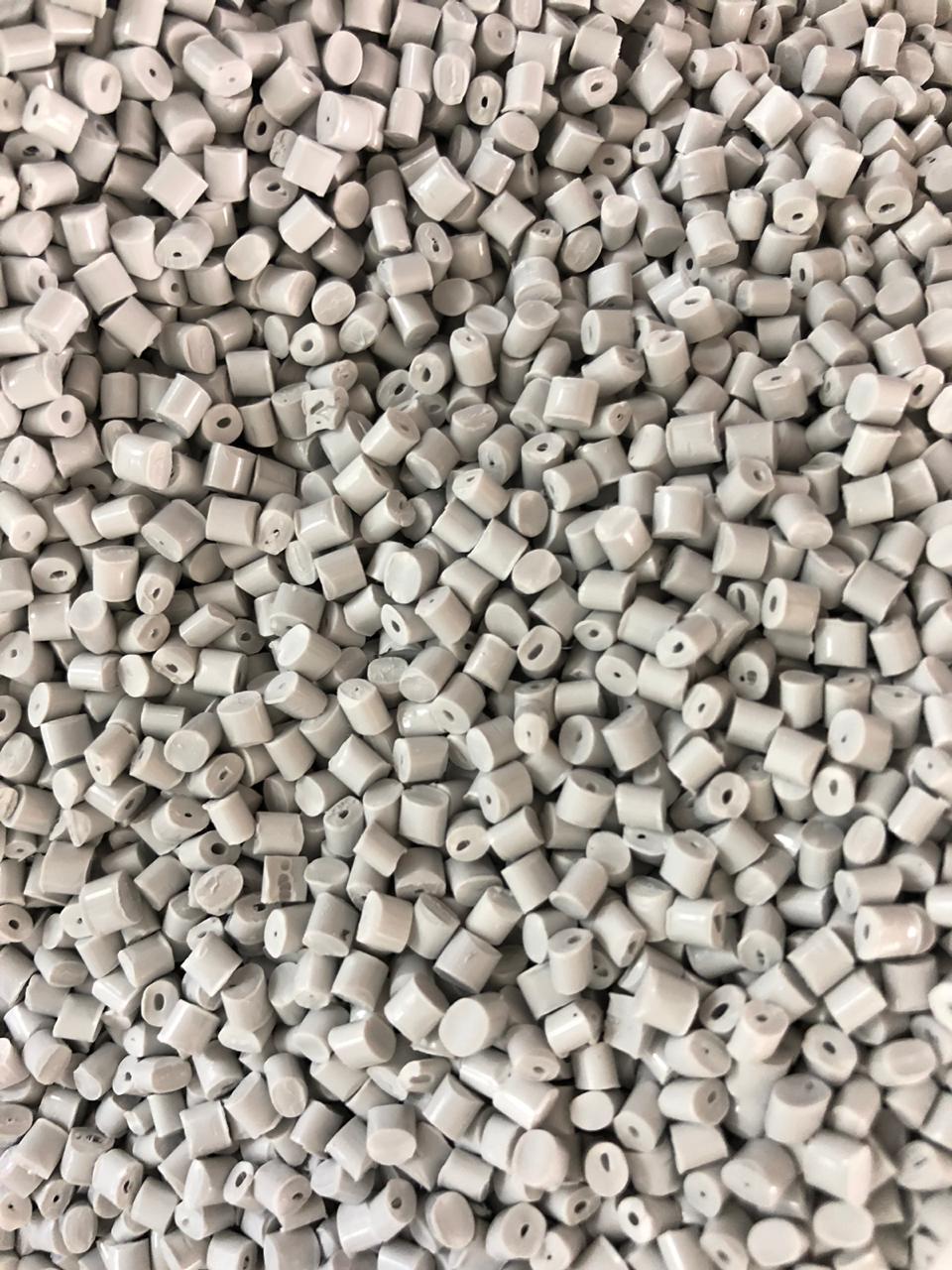
Printerior, a large-format additive manufacturing (LFAM) specialist based in Missouri, is now selling the pellet grades it compounds for its own printing service to outside buyers. As VoxelMatters reported, the company has nine grades in stock and ready to ship, more than 15 formulated and ready for production, and more than 35 combinations it will compound on request. All of it can be made from up to 100% recycled US plastic waste, and the company puts its US production capacity at up to 1 million pounds (about 450,000 kg) a year.
The move turns an in-house material operation into a supply business. It also adds a domestic, recycled-content option for a part of the industry that buys plastic by the gaylord, not the spool.
From Captive Supply to Catalog
Printerior did not start out as a pellet vendor. According to the company's announcement, as relayed by VoxelMatters, it has been compounding its own filament and pellets since 2021 and has run an LFAM printing service since 2024. The material it is now offering externally is the material it has been using in its own printing services. The company says more than 250,000 lb (roughly 113,000 kg) of Printerior material went into finished parts in 2026.
That history matters for how buyers should read the launch. A compounder that also prints at production scale has, at least in principle, been its own most demanding customer: when a grade warps or a bead slumps, the company finds out on its own print bed. Neither trade write-up includes independent test data, though, so the performance claims below come from the company.
3D ADEPT confirms the catalog structure: nine grades in stock, more than 15 formulated grades available on order, and more than 35 combinations on request. It adds that every grade is produced at Printerior's facility in Chesterfield, Missouri.
Why LFAM Pellets Are Their Own Problem
Anyone who has tuned a desktop printer knows that a material's behavior in the melt matters as much as its datasheet strength. At large-format scale that gets harder. As 3D ADEPT explains, LFAM materials have to do three things at once to print a part several meters long correctly: flow evenly through the extruder, hold their shape after deposition, and barely shrink while cooling.
Each of those requirements follows from the way large-format systems work. They lay down thick beads, and those beads have to carry the weight of the layers stacked on top of them while they are still cooling. A material that flows inconsistently tends to give uneven beads. One that sags after deposition loses dimensional accuracy as the part grows taller. One that shrinks noticeably as it cools builds up stress across a large part. A small amount of shrinkage that a desktop part shrugs off adds up over a print measured in feet.
Printerior says its grades are tuned for exactly these properties, namely melt flow, bead stability and low shrinkage. The company also says each pellet lot is tested for melt flow and strength and traced from raw material through to finished pellet. For recycled feedstock, that lot-level testing and traceability is arguably the most important part of the pitch. Post-consumer and post-industrial plastic streams vary, and the usual worry about recycled pellets is batch-to-batch inconsistency rather than average performance.
Where the Plastic Comes From and Where It Goes
According to the VoxelMatters report, Printerior reclaims post-consumer and post-industrial plastic, including food packaging, cosmetic waste and manufacturing scrap, and compounds it into pellets made from up to 100% recycled US plastic waste. The phrasing matters: "up to" 100% means recycled content can vary by grade, and buyers who need a specific figure for sustainability reporting should ask for it grade by grade.
The company also offers an end-of-life service in which customers send parts back and Printerior shreds them into new material. That fits naturally with the kind of work LFAM is often used for. Tooling, molds and fixtures can be large, short-lived and made of a single material, so a return path for them is more useful than it would be for consumer products.
Chief executive Trent Esser, who is also a co-founder, framed the launch around those applications. In the quote carried by both outlets, he said more manufacturers are turning to LFAM for tooling, molds and large production parts, and that they need specialized material made for the process and a supplier they can count on.
How Buying Works
3D ADEPT describes a buying process built for qualification. Customers can start with a sample jar or a 25 kg trial box, then move up to a gaylord or a full truckload of the same grade. That ladder matters because a large-format print can use a lot of material, and nobody wants to commit to a truckload before confirming that a grade behaves on their extruder, at their temperatures and with their bead geometry.
3D ADEPT also gives a rough picture of the range. The stocked grades include rPETG, UV-stabilized rPETG and rPLA, plus glass-fiber rPETG grades, one of them rated UL 94 V-0. Custom grades combine base resins with additives; the resins named include rPA6, rPA12, rPC, rABS, rASA and rTPU, and the additives include carbon fiber, halogen-free flame retardant and ESD additives. Printerior also offers virgin versions of every grade.
Neither report includes pricing or mechanical property tables. Buyers will need to get those from the company directly.
What It Means for Makers
For most desktop users this announcement is background. Printerior is selling pellets in quantities sized for industrial LFAM cells, not consumer filament. But the segment of the maker world that has moved into large-format work has reasons to pay attention. That includes makerspaces with pellet-fed gantries, small fabrication shops printing molds and fixtures, and builders running hobby-scale pellet extruders.
- A low-commitment way in. The sample jar and 25 kg trial box tiers mean a small shop can test a grade without buying a gaylord, though buyers should confirm pricing and minimums with the company.
- Recycled content with a paper trail. Lot testing and raw-material-to-pellet traceability go straight at the most common objection to recycled feedstock, which is inconsistency. Ask for the lot data and see whether it holds up.
- Domestic supply. Production in Chesterfield, Missouri, with stated capacity of up to 1 million lb a year, gives US buyers a local source with no overseas shipping, according to the company.
- A closed loop for big, short-lived parts. The end-of-life shredding service gives retired molds and tooling somewhere to go besides a dumpster.
The caveat is that, so far, everything rests on the company's own statements as reported by trade press, and no third-party data on the grades has been published. The sensible approach is the one the company's own ordering ladder suggests: start with a sample, print something that actually matters to you, and scale up only if the beads behave.
Bottom Line
Printerior is turning several years of in-house compounding into an external pellet catalog: nine grades in stock, more than 15 formulated, more than 35 combinations on request, all made in Missouri from up to 100% recycled US plastic. The pitch is consistency, traceability and a take-back loop, aimed at tooling, molds and large production parts. Whether recycled LFAM feedstock can match virgin material lot after lot is something buyers will judge one trial box at a time.
