
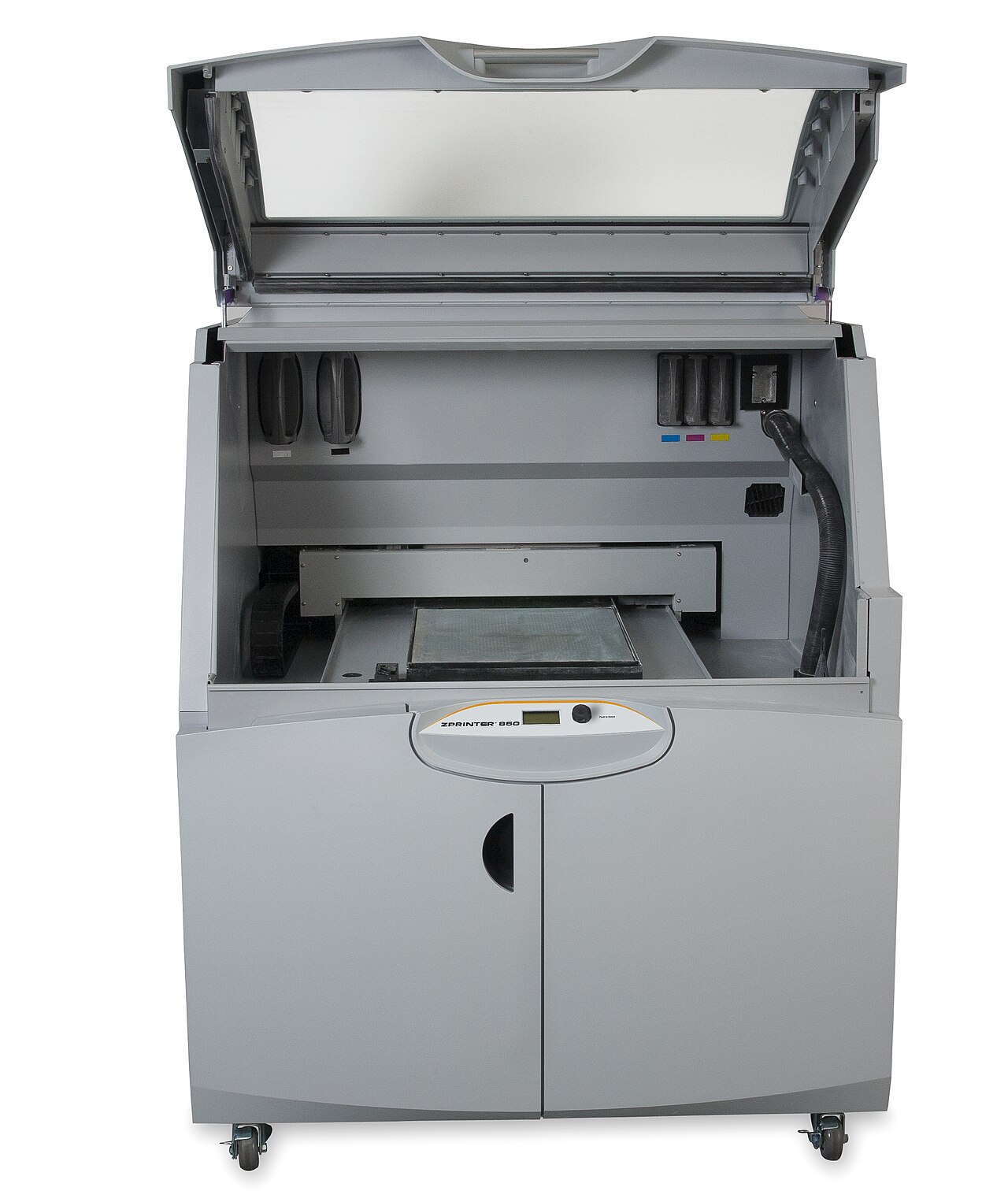
3D Systems used Formnext 2026, held in the company's 40th anniversary year, to show the next generation of its MultiJet line. The new MJP 300 prints acrylate parts on wax supports. Its build area is 294 x 211 x 144 mm and can be split into three separate lanes, and its finest mode, XHD, prints 16-micron layers. VoxelMatters reports that the machine was on show in Frankfurt and goes on sale in the first quarter of 2027. The company also announced a larger-format wax kit for its MJP 300W Plus casting printer, a closed-loop powder module for the DMP Flex 350 metal system, and security upgrades to its 3D Sprint software.
The MJP 300 is not a desktop printer. It is a professional jetting printer that 3D Systems calls its easiest-to-use model, built for daily production of parts. Still, the MultiJet approach is marketed for fine detail and smooth surfaces in plastic parts. If you have ever compared your own resin prints with a professionally printed sample, the comparison is worth understanding.
How MultiJet Printing Works
MultiJet printing (MJP) is a form of material jetting. Instead of curing a vat of resin one layer at a time, as SLA and MSLA printers do, an inkjet-style printhead deposits droplets of photocurable acrylate where the part goes and droplets of wax where support is needed. Each pass is cured with UV light. When the build finishes, the part is surrounded by wax. On the MJP 300, parts are released from the build plate with a low-temperature heater or chiller, then cleaned in 3D Systems' bench-top MJP EasyClean System with a bath and a rinse. According to 3D Systems, the process needs no manual scrubbing or waterjet.
That wax-support approach is the main reason the process exists. Overhangs, internal channels and delicate features that would need dense support trees on a hobby resin printer can be supported by wax instead, which is removed in the cleaning step rather than clipped off.
The Numbers
According to the 3D Systems product page, the MJP 300 has three print modes:
- HD: 800 x 900 x 800 DPI, 32-micron layers
- UHD: 1600 x 900 x 800 DPI, 32-micron layers
- XHD: 1600 x 900 x 1600 DPI, 16-micron layers
The jump from HD to UHD doubles resolution along the first axis while keeping the same layer height. XHD doubles the third figure too, halving layers to 16 microns. The page marks the modes as material and geometry dependent. 3D Systems quotes accuracy of plus or minus 0.0508 mm per 25.4 mm, which is 0.002 inches per inch, and a minimum feature size of 200 microns.
The three-lane build area is the more interesting operational change. According to 3D Systems, splitting the build area lets an operator group small or tall parts into lanes for faster production without compromising quality. The page also says the printer can handle same-day turnaround of small parts and single-lane builds, as well as large overnight runs. For a service bureau or an in-house design team, that flexibility could reduce waiting, though the sources do not quantify it.
The machine measures 1120 x 740 x 1070 mm. 3D Systems says it fits through a standard 30-inch doorway and runs on standard AC power. The room needs ventilation of at least four air changes per hour. The cartridge design is described as safe to touch and suited to an office or professional setting.
Materials and Uptime
VoxelMatters reports that the printer will launch with five VisiJet acrylates. The product page lists them as VisiJet M2R-CL, M2R-WT, M2R-TN, M2S-HT90 and M2P-CST Crystal. VoxelMatters' report names some of them slightly differently (M2R-WH, M2R-HT90 and M2P-Crystal), so buyers should confirm exact grades with 3D Systems before ordering. Going by the product page descriptions, the list covers clear, white and tan rigid materials, a transparent high-temperature grade, and a translucent castable one.
Material handling is built for long, unattended runs. A four-bay drawer holds two build-material cartridges and two wax-support cartridges, and the printer switches to a full cartridge automatically when one runs out. For anyone who has woken up to a failed overnight print because a resin tank ran low, the appeal is obvious.
On the software side, the MJP 300 is supported by 3D Sprint, which handles automatic part orientation and placement and model repair. 3D Sprint Pro now integrates the .finite digital rights management toolset, which protects print data by preventing unauthorized access when it is shared. VoxelMatters says .finite will be available first for the MJP 300W and the MJP 300, with more models to follow in early 2027. This matters more as companies outsource production of proprietary components.
The Rest of the Formnext Lineup
The Industrial Wax Kit for the MJP 300W Plus, the wax-casting printer 3D Systems first launched in 2025, allows larger casting patterns printed in VisiJet Wax Jewel Red. The 300W Plus has been used for wax casting patterns in the jewelry sector. According to VoxelMatters, interest from sectors such as aerospace prompted the kit, and Martin Johnson says the machine has turned heads in the aerospace community.
For metal, the new Transport-Sieve-Reload (TSR) module is a mobile, closed-loop powder-management unit for the DMP Flex 350. It integrates technology from Russell Finex, operates under fully inert conditions and can be used with multiple DMP printers. It covers powder recovery, sieving and recirculation, which helps preserve powder quality for reuse and reduces operator contact with the metal particles.
Martin Johnson, 3D Systems' VP of Product and Technical Fellow, spoke for the company on the launches, according to VoxelMatters.
What It Means for Makers
Nobody is putting an MJP 300 on a garage workbench. But the launch matters to the maker community in two practical ways.
First, service bureaus. Many makers already order parts from print services when a project needs detail or surface quality their own machines can't deliver: miniature masters, snap-fit enclosures, clear light pipes, or patterns for casting. A machine that can run lane-based builds and swap material cartridges without stopping is built for that kind of mixed, small-batch work. If bureaus adopt it after the Q1 2027 launch, that could mean shorter queues for small orders, although 3D Systems has made no claims about pricing.
Second, a reference point. The specs, with 16-micron layers and a 200-micron minimum feature size, show where high-end jetting sits compared with a well-tuned MSLA printer. For many hobby uses, a good resin printer gets close enough. The gap is likely clearest in support-free complex geometry and in repeatable accuracy across a full build, though that is our judgment rather than a tested comparison. If your work depends on either, outsourcing to MultiJet may still make more sense than buying a higher-end resin printer.
For jewelers and small casting shops, the Industrial Wax Kit is a sign that 3D Systems sees growth in printed patterns beyond jewelry.
Bottom Line
The MJP 300 builds on an established MultiJet platform. Its headline changes are lane-based builds, automatic cartridge switching, a 16-micron mode, and a footprint that fits through a standard doorway. Its success will depend on pricing and on how quickly bureaus put it into service when it ships in Q1 2027.
