
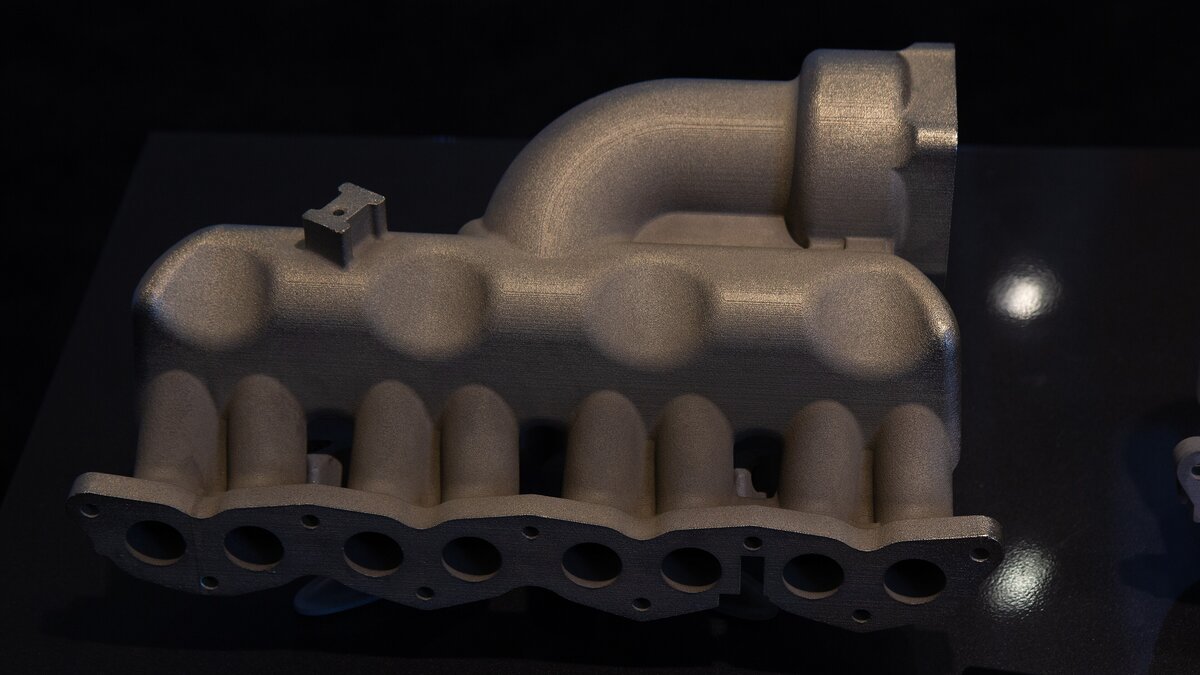
Stratasys launched a new machine in its Selective Absorption Fusion (SAF) line at Formnext 2026 in Frankfurt, unveiling it on November 17. The SAF H550 is a larger polymer powder-bed printer joining the H350, with a 365 x 208 x 450 mm build envelope, or 34.2 liters. Pre-orders opened on November 17, and the company plans commercial availability for the second quarter of 2027. Alongside it, Stratasys introduced PowderEase T2, an automated station for the powder handling that usually eats into the time savings of powder-bed systems.
Few makers will put an industrial powder-bed machine in a garage. Plenty of them buy nylon parts from service bureaus, though, and the H550 is aimed squarely at the bureaus and production shops that make those parts. What changes in that market changes what a quote for a run of drone arms or custom ducts looks like.
The Numbers, and Where They Come From
Every comparison figure Stratasys gives is measured against its own H350, which VoxelMatters notes has been on the market for about five years. According to the product page, the H550 offers:
- A build volume nearly 80% larger than the H350's
- Parts up to 40% longer
- More than twice as many parts per build
- Up to 50% higher throughput
- 100-micron layer thickness
Stratasys says these numbers depend on part size, nesting and material, which is the usual caveat for throughput claims on powder-bed machines. A tightly nested build of small brackets and a bed holding a few long manifolds behave very differently, so treat the 2x parts-per-build figure as a best case for packing density, not a guarantee.
The more competitive claims are pointed outside the company. VoxelMatters reports that the 450 mm long axis is 20% longer than that of the leading comparable print-and-fuse system, and that the H550 is designed for up to 30% lower total cost of ownership than comparable print-and-fuse systems. The competitor goes unnamed. In the print-and-fuse category, most readers will think of HP's Multi Jet Fusion first, but until independent cost and throughput data exist, both figures should be read as vendor positioning.
Why the Bed Is Shaped Like That
The most interesting design choice is the shape of the envelope, not its volume. The H550 isn't a scaled-up cube. At 208 mm, the Y axis stays fairly short, while X and Z grow. Neil Hopkinson, Stratasys' VP of AM Technology and the inventor of High Speed Sintering, the process SAF descends from, told VoxelMatters that the goal was a more planar build that limits powder aging.
Anyone who has worked with powder-bed nylon will know the issue. Unfused powder that sits at temperature through a long build degrades, and how much of it can be reused determines both material cost and part consistency. In a cubic build, powder at the center of the cake sits far from every wall, so it cools slowly and ages more; a more planar bed limits that. Stratasys pairs that geometry with upgraded thermal control, distributed heating and thermal sensing, and a new thermal imaging camera, all aimed at keeping the fused area predictable over a larger footprint.
Hopkinson also said the H550 has the same external footprint as the H350. For a service bureau with limited floor space, that matters more than it sounds. Stratasys also says the system needs less infrastructure than comparable systems, which should simplify installation.
Stratasys says the industrial printheads don't need routine replacement, which affects operating cost as much as the machine price does. The product page lists compatibility with SAF PA12 Powered by Evonik, among other qualified SAF materials.
PowderEase T2: The Unglamorous Half of the Launch
On powder-bed systems, the printer is rarely the only bottleneck. Breakout, depowdering, sieving and refilling take operator time and expose staff to loose powder. PowderEase T2 automates unpacking, powder retrieval, recycling, sieving and dosing. Stratasys says one station can serve up to six H550 systems running the same material, with operator time under 30 minutes per build.
The station also handles H350 builds in the same material, so an existing SAF shop can run both generations through a single powder workflow without keeping separate handling lines. That backward compatibility will likely influence buying decisions as much as the printer specs do.
Target Parts
Stratasys lists UAV components, robotics and end-of-arm tooling, medical devices, automotive parts, and manifolds and ducts as target applications. The longer axis explains most of that list. Drone arms and fuselage sections, gripper fingers, and air ducts all tend to be long and thin, and on a shorter bed they have to be split into segments and bonded or placed diagonally, which wastes nesting space.
"Parts up to 40% longer" in one piece means fewer joints, and that means fewer weak points and less assembly labor. Rich Garrity, Stratasys' Chief Business Unit Officer, presented the launch as a way to give customers more production capacity on the SAF platform. That reading is fair, given that the H550 shares materials and powder handling with the H350.
What It Means for Makers
If you design parts and send them out for powder-bed printing, the H550 matters in three ways, all of them indirect and none before mid-2027.
Longer single-piece parts. Bureaus that buy the H550 should be able to quote nylon parts approaching 450 mm long without splitting them. If your designs currently come back in two pieces with an alignment key, that may change.
Price pressure, possibly. If the throughput and cost-of-ownership claims hold up in production, bureaus get more parts per hour of machine and operator time. Whether those savings reach customers depends on competition.
Another credible route to production nylon. Service bureaus that offer laser sintering and print-and-fuse processes now have a larger SAF option to compare. More capacity across more processes could mean more choice, especially for volumes that are too small for molding and too large for a desktop printer farm.
The caveats are familiar. The machine isn't shipping, every comparison number comes from Stratasys, and the claim against print-and-fuse rivals names no rival. The design choices themselves, a planar bed to protect powder, the same footprint as the H350, and a powder station shared across both generations, look like decisions made by people who have run these machines in production. Independent production data should start to appear once bureaus run the H550 in 2027.
