
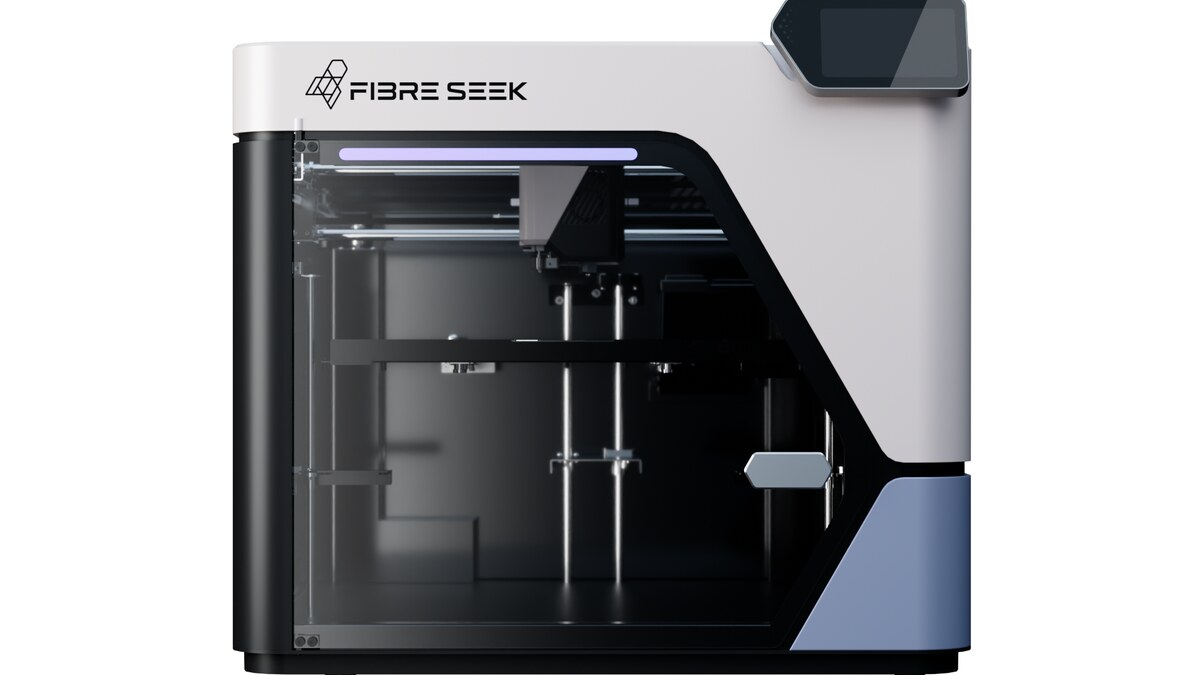
Continuous-fibre 3D printing has spent most of its commercial life behind a price wall. FibreSeek wants to tear it down: the company bills its FibreSeeker 3 as the "World's First Consumer Continuous Fiber 3D Printer," an enclosed CoreXY machine that pairs a conventional FFF hotend with a second nozzle that lays continuous carbon or glass fibre into the part as it prints. This week 3D Printing Industry published a hands-on review asking whether a machine with a $3,499 suggested retail price can actually produce real composites, rather than plastic with some chopped fibre stirred in. The question matters because the answer decides whether stiff, strong structural parts move from industrial labs onto ordinary workbenches.
Who Built It, and Why That Matters
FibreSeek is not a garage newcomer. According to 3D Printing Industry, the company was founded by the original team behind Anisoprint, a composite 3D printing specialist. That lineage shows in the FibreSeeker 3's architecture, which the review describes as FFF plus Composite Fibre Co-extrusion (CFC). The project raised more than $4.7 million on Kickstarter before moving to general sale, and the review reports that shipments of the composite-extrusion hardware began in the second quarter of 2026, after FibreSeek fulfilled its Kickstarter orders.
The obvious point of comparison is Markforged, the brand most makers associate with continuous-fibre printing. The review contrasts the two directly: Markforged's machines cost several times more and lock users into proprietary materials. Markforged is itself now part of Stratasys' pending acquisition, which leaves the high end of the category in some flux just as a cheaper challenger arrives.
The Hardware
On paper, the FibreSeeker 3 reads like a modern high-speed enclosed printer that happens to carry a second, unusual toolhead. The relevant specifications, drawn from the manufacturer's store page and the review:
- Motion and enclosure: CoreXY kinematics in a fully enclosed frame with glazed front, left and top panels.
- Build volume: 300 x 300 x 245 mm.
- Speed: up to 500 mm/s, per FibreSeek.
- Nozzles: a 0.4 mm hardened steel FFF nozzle and a 0.7 mm hardened steel CFC nozzle, both reaching 350C, with an automatic fibre cutter.
- Chamber: active heating to 65C.
- Bed: magnetic spring-steel plate rated to 120C, with load-cell auto-leveling built into the toolhead.
- Monitoring: AI error detection, according to the store listing.
The heated chamber and hardened nozzles are not luxuries here: a machine meant for engineering materials and applications needs both. The review does flag one hardware concern, though. On several occasions the printer issued overheating warnings that required opening the panels to cool the chamber, which could be a problem on longer prints in high-temperature filament.
How the Fibre Gets In
The interesting part is the software. FibreSeek's Rocket Slicer offers three modes, and they map neatly onto how most people would actually use such a machine:
- Speedy uses only the FFF nozzle, for fast prototypes and non-structural parts, with no fibre at all.
- Reinforced lets the user set the magnitude of reinforcement and define reinforcement zones manually with masking tools, so a bracket could get fibre where its loads run without wasting material elsewhere.
- Fortified applies fibre throughout much of the part for maximum stiffness and strength, at the cost of more fibre and longer print times.
That middle mode is where continuous-fibre printing earns its keep. The review likens the fibre to rebar in concrete: the polymer gives the part its shape while the unbroken strand carries the load. A slicer that exposes zone control gives an experienced user the lever that matters.
FibreSeek's headline claim is composite tensile strength of up to 900 MPa. Treat that as the manufacturer's best-case figure, not a number an arbitrary part will reach; real-world strength depends on fibre fraction, orientation and the matrix holding it together. The review also notes that its own benchmarks were run in PETG through the FFF nozzle only, so they say little about fibre-reinforced accuracy or strength.
The Materials Catch
Here is where the "open versus proprietary" story gets more nuanced. On the matrix side, the FibreSeeker 3 is reasonably open: the review lists PLA, PETG, PC, PA, PA-CF and PETG-GF as supported filaments. On the reinforcement side, it is not. The continuous fibre must be FibreSeek's own X-CCF carbon or X-CGF glass. That is less restrictive than an ecosystem where every spool comes from one vendor, but it still means the most consequential consumable in the machine has a single supplier. Anyone planning production use should factor fibre pricing and availability into the real cost of ownership, not just the sticker price.
What Does It Actually Cost?
The price depends on when you look. 3D Printing Industry's review headline and text use the $3,499 general-sale SRP. When FilamentFeed checked FibreSeek's US store, the printer was listed at $2,699 against that $3,499 reference price, an $800 discount framed as a BFCM (Black Friday and Cyber Monday) promotion. The same page showed the Add to Cart button as out of stock. In other words, the promotional price is real but the printer was not purchasable at that moment, and the $3,499 figure is the one to plan around once the holiday sale ends.
Bottom Line for Makers
The FibreSeeker 3 is the clearest attempt yet to put true continuous-fibre reinforcement into a machine priced like a high-end hobbyist or small-shop printer. The pedigree is credible, the hardware checks the boxes that engineering materials demand, and the Reinforced slicer mode gives users meaningful control over where fibre goes.
The trade-offs are just as clear. Reinforcement is locked to FibreSeek's two fibre products, the 900 MPa figure is a manufacturer claim, and stock was unavailable at the time of writing. For makers who build jigs, fixtures, drone frames, brackets or anything else where stiffness-to-weight actually matters, this is a machine worth watching closely. For anyone who mainly prints PLA and PETG, the Speedy mode makes it a capable enclosed CoreXY printer, but you would be paying a premium for a second toolhead you rarely use.
The broader signal is hard to miss. With Markforged part of a pending Stratasys deal and a Kickstarter-funded rival shipping composite hardware for a fraction of the price of Markforged's machines, continuous fibre is starting to look less like an industrial specialty and more like a feature desktop printers may be expected to offer.
