
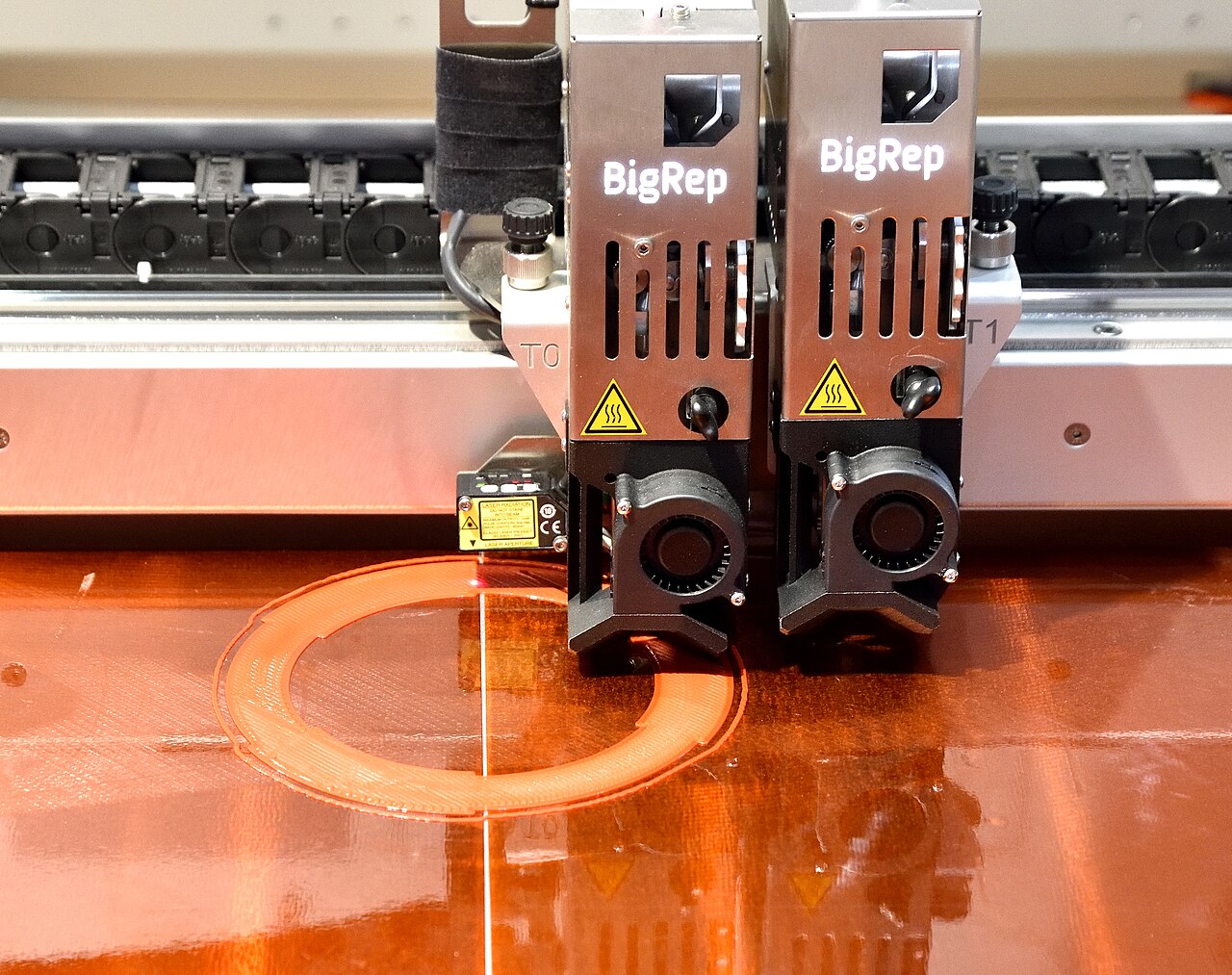
BigRep has used Formnext 2026 to move its flagship large-format platform off the filament spool. The company's new PELLEX 750 takes the BigRep ONE platform and fits it with a pellet extruder from Massive Dimension, producing a 750-litre machine that BigRep pitches around three things: high-speed printing, lower material costs and material flexibility. The headline number is throughput. The MDX Pellet Extruder is rated at up to 4,000 g/h, a deposition rate well beyond what most makers expect from filament machines.
The PELLEX 750 is not a clean-sheet design, and that matters. According to TCT Magazine, it is built on the same technology as the BigRep ONE and even keeps that machine's flagship orange shell. What changes is the business end: filament extrusion gives way to granulate fed through Massive Dimension's MDX extruder. The launch arrives one year after BigRep first announced it was working with Massive Dimension on a large-format pellet-based system, so this is the first visible product of that partnership rather than a speculative concept.
Why pellets, and why now
Pellet extrusion has long been the obvious answer to two problems that dominate large-format printing: time and feedstock cost. Once a build volume is measured in hundreds of litres, a filament machine spends hours laying down the volume of a single part, and the filament itself becomes a meaningful line item. Pellets attack both. They are the raw form that filament is made from, which removes a manufacturing step from the supply chain, and a screw-type extruder can push far more molten plastic per hour than a hotend fed by a filament strand. BigRep's own product page says pellets cost only a fraction of filament prices, and that large nozzles and big layer heights let you print massive parts in just a few hours.
BigRep's own framing reflects that trade. The company's product page positions the PELLEX 750 for prototypes, tooling and end-use parts, with particular emphasis on what it calls massive tooling, meaning jigs and fixtures, along with creative large prints for architecture and displays. Those are applications where a part's sheer size and the speed of producing it matter more than the fine surface detail a small nozzle would give.
The timing also makes sense from a product strategy point of view. BigRep calls the ONE a trusted platform, and reusing it means the machine's existing hardware and workflow carry over. Pairing an established machine with a third-party extruder looks like a lower-risk path into pellets than designing a new machine from scratch, and it lets BigRep offer a pellet option to customers who already understand its large-format hardware.
Materials: open, with a short recommended list
One of the more maker-relevant details is the material policy. BigRep says its machines are open to compatible third-party materials, and TCT reports that the PELLEX 750 is open to any compatible material. That is a meaningful distinction in a segment where some vendors lock customers into proprietary granulate.
Open does not mean fully profiled, however. At launch the recommended materials are PETG and PETG CF, both supported with dedicated slicing profiles, and BigRep says more profiles are coming. In practice, that means early adopters who want to run anything beyond those two will likely be doing their own process development: dialling in temperatures, flow and cooling for an extruder moving material at kilograms per hour. That is not trivial work, but it is the kind of freedom that shops already running their own materials tend to value.
The choice of PETG and its carbon-fibre-filled variant as the starting point is sensible. Both are familiar to anyone who has printed functional parts, and the CF version should add stiffness that suits fixtures and moulds, which are the kinds of applications BigRep is targeting.
The Formnext demo: a turbine blade mould in under five hours
BigRep chose a demonstration piece that speaks directly to the tooling pitch. At Formnext, TCT reports, the company showed a large wind turbine blade mould printed in Airtech Dahltram T-100CF in just under five hours. The CF suffix points to a carbon-fibre-filled grade, and a mould for a composite part is a textbook case for large-format pellet printing: a big, structurally demanding object where getting a usable tool quickly can shorten an entire product development cycle.
The demo also hints at how the open-material approach is meant to work. Airtech's material is not one of the two launch-recommended options, yet it was the material BigRep put on the stand. That suggests the company expects serious users to bring engineering-grade granulate from established suppliers rather than buying everything from BigRep.
What It Means for Makers
Let's be realistic about who the PELLEX 750 is for. A 750-litre industrial pellet printer is not going on a workbench in a garage. Its natural home is likely a fabrication shop, a design studio, a tooling department or a makerspace with institutional backing and a steady stream of large jobs.
Still, the machine is worth paying attention to for a few reasons, even if you never stand next to one.
Pellets are moving into mainstream large-format lineups. When a company with an established filament platform adds a pellet version of the same machine, it suggests granulate extrusion is maturing from an exotic option into a standard configuration. That trend tends to trickle down over time in tooling, slicer support and material availability.
Open materials remain a selling point. BigRep leaning into compatibility with third-party materials, and demonstrating with one at its own launch, reinforces a principle makers care about: you should be able to choose your feedstock. The catch is that open systems shift the profiling burden onto the user until the vendor's library catches up.
Tooling is the killer app. The use cases BigRep highlights, including jigs, fixtures and moulds, are where large pellet printers earn their keep. If you run a shop that currently outsources big moulds or spends days fabricating fixtures, a turnaround measured in hours on a part like a turbine blade mould is the number that will get attention.
For individual makers, the most practical takeaway may be indirect. Contract print services and well-equipped community shops are the ones likely to invest in this class of hardware, and that could make large, fast, cheap-per-kilogram prints more accessible as a service even for people who will never own the machine.
Bottom Line
The PELLEX 750 is a pragmatic product: the BigRep ONE platform, a high-throughput Massive Dimension extruder, a 750-litre envelope and an open-material stance with a short but growing list of profiles. It lands a year after the two companies announced their collaboration, and it arrives with a demo that makes the tooling case plainly. The open questions are the ones that only time in production will answer, starting with how quickly BigRep expands its profile library beyond PETG and PETG CF.
