
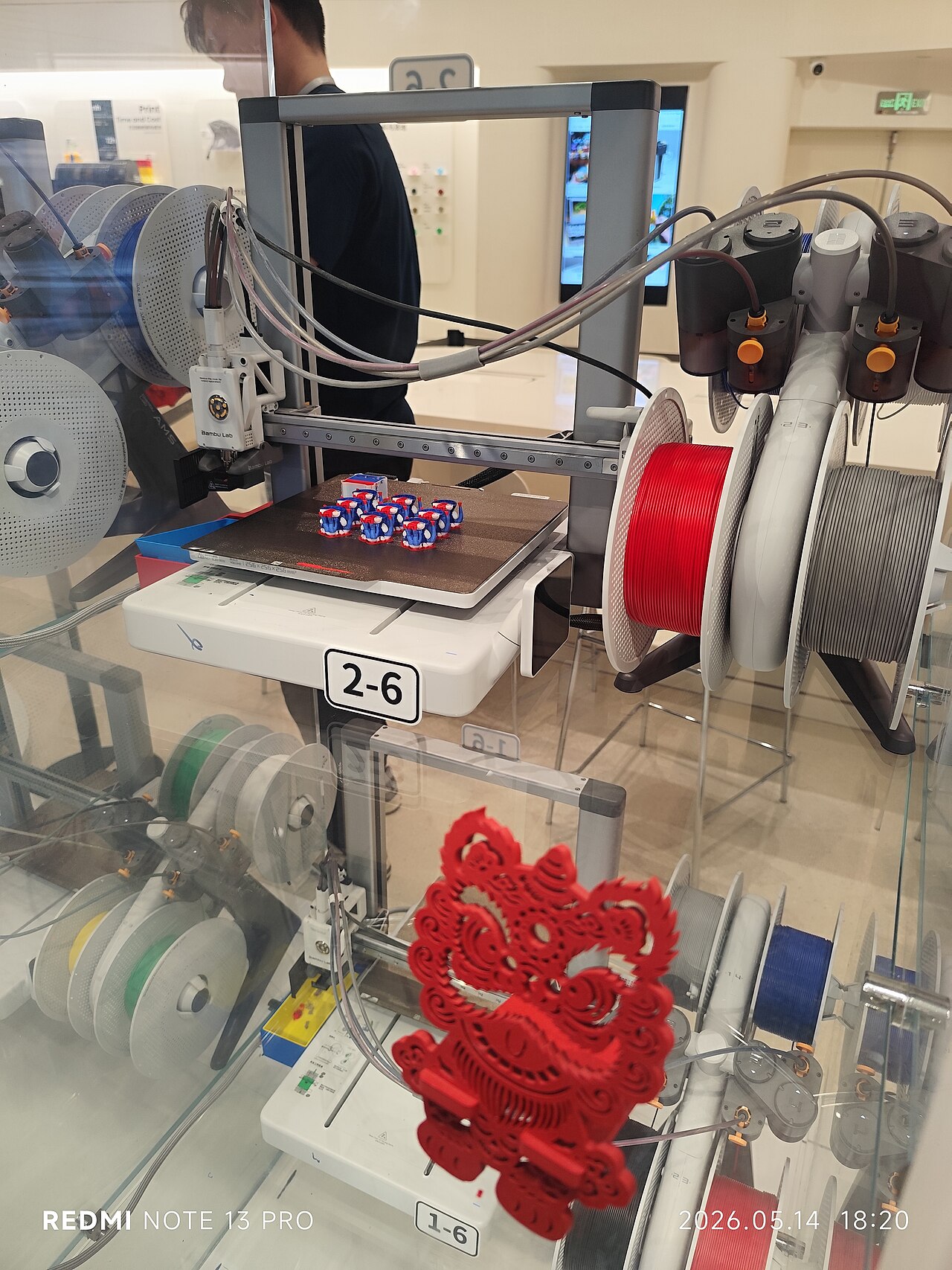
Desktop 3D printing is no longer a niche that sits beside "real" additive manufacturing. According to a new study by consultancy AMPOWER, produced with the Manufacturing Technology Deployment Group (MTDG), 5.2 million desktop printers were sold worldwide in 2025, up 34% from 3.88 million in 2024. The same work finds that 94% of those machines are built in China, and that four of the five largest manufacturers by 2025 unit volume sit in the Shenzhen region. The full study is gated behind a request form, but AMPOWER's public summary and reporting by 3D Printing Industry lay out the shape of a market that has grown faster, and concentrated more, than many in the industry expected.
The Numbers
The headline figure is volume. Going from 3.88 million to 5.2 million units in a single year is a 34% jump, and it sits on top of a 22.4% compound annual growth rate since 2020. In other words, 2025 was not a one-off spike; it was an acceleration of a trend that was already steep.
Material consumption tells a similar story. AMPOWER puts filament consumption at about 60,000 tonnes in 2025, up almost 43%. Filament growth outpacing printer growth is consistent with a busy installed base, though 3D Printing Industry cautions that rising material consumption does not by itself establish greater utilisation per machine, because the installed fleet is also expanding.
The market is also top-heavy. The five largest suppliers account for 86% of sales, which leaves a thin slice for everyone else, from long-established Western brands to small kit makers.
Shenzhen's Share
The geographic concentration is the figure that will draw the most attention. By AMPOWER's count, 94% of desktop additive manufacturing printers are made in China. Europe accounts for 4% of production and the rest of the world for 2%. Four of the top five OEMs by 2025 unit volume are based in the Shenzhen region, where, as 3D Printing Industry puts it, nearby materials producers, component suppliers and equipment manufacturers have helped turn the area into a centre of rapid product development. AMPOWER names Creality, Bambu Lab and Elegoo among the manufacturers that have grown into global players, and notes that major filament makers such as eSUN and Sunlu are located in the same region.
Demand, however, is spread across Asia-Pacific, Europe and the Americas. The United States is the largest user market, and there more than 90% of users are private individuals rather than businesses. The flow of the industry, then, is machines designed and built in southern China and sold around the world, with the US as the biggest user market and individuals as its core buyers.
That consumer orientation shows up in retail, too. 3D Printing Industry reports that Bambu Lab printers were on sale in 262 Apple stores in China as of the end of September 2026, up from 60 when the rollout began.
Twelve Years of Price Compression
AMPOWER illustrates the economics with a simple comparison. The Ultimaker 2, launched in 2013, cost about EUR 2,000 and printed at 30 to 300 mm/s. The Bambu Lab P2S, released in 2025, costs about EUR 500 and prints at up to 600 mm/s. That is a 75% drop in price alongside a doubling of the top speed figure, and AMPOWER also credits significantly improved component quality.
Capability that once commanded a professional-tool price now sits at a consumer-electronics price point, and that shift is a plausible driver of the volume numbers above.
Desktop Machines on the Factory Floor
The more interesting argument in the study is that this consumer hardware is changing industrial economics. 3D Printing Industry opens at Huafast, a Shenzhen operation where thousands of desktop machines manufacture toys and other products, and where on some equipment getting a design into production still involves carrying an SD card to the printer, because wireless interference makes sending files across the factory unreliable. When individual printers cost EUR 500 to 1,000, a manufacturer can add capacity in small increments: a business can test a design, take orders and buy further printers as demand develops, rather than committing to a single large capital purchase.
That logic puts pressure on the middle of the equipment market. Timo Führer, a partner at AMPOWER, told 3D Printing Industry that Bambu Lab is eroding the position of suppliers selling equipment in the EUR 5,000 to 10,000 range. If a farm of sub-EUR 1,000 printers can deliver the throughput a buyer needs, the case for a single machine costing five to ten times as much has to rest on something other than speed or price. Führer sees room for European suppliers among customers concerned about data security and in regulated industries such as defence, though at smaller volumes than the consumer market offers.
Führer also expects the market to eventually be dominated by five to ten companies, with room for specialists. Given that the top five already hold 86% of sales, that forecast describes less a future upheaval than the continuation of where things already stand.
Where the Software Effort Is Going
AMPOWER also looked at how artificial intelligence is being applied in additive manufacturing. Its market overview finds that most available solutions address design and simulation and the printing process itself, for example through image-based detection of first-layer defects, clogged nozzles, foreign objects or extrusion failures. Post-processing and quality management are barely covered and remain well below their potential in maturity and impact. AMPOWER points to support removal, part sorting, quality control and the orchestration of queuing and machine setup as where the greatest leverage lies. For anyone running more than a handful of machines, that gap is notable, and 3D Printing Industry reports that filament changes, part removal, inspection and packaging are still commonly done by hand.
What It Means for Makers
For individual makers, the near-term picture looks largely favorable. Prices have fallen sharply relative to 2013, performance has climbed, and desktop printers are now sold through mainstream retail in at least one major market. The near-43% rise in filament consumption points to growing activity, though as noted it is not proof that each machine is working harder.
The trade-offs are concentration and dependence. With 94% of production in one country, and most of the largest makers in one region, the hobby's hardware supply could be exposed to whatever affects that region's manufacturers, from trade policy to logistics. And if Führer is right that the market settles around five to ten dominant companies, buyers may have fewer independent options when it comes to ecosystems, spare parts and long-term support.
For makers running small businesses or print farms, the Huafast example is the more practical takeaway. Inexpensive desktop machines can be scaled in small increments, and the economics of adding capacity in EUR 500 to 1,000 steps are hard to argue with. The weak points are the ones the reporting identifies: post-processing, inspection and packaging remain largely manual, and that is where the labor in a larger operation will pile up.
The bottom line is that the desktop printer has become a mass-market product with industrial side effects. The machines on a hobbyist's bench and the machines in a contract manufacturer's racks are increasingly the same kind of machine, built in the same region.
