
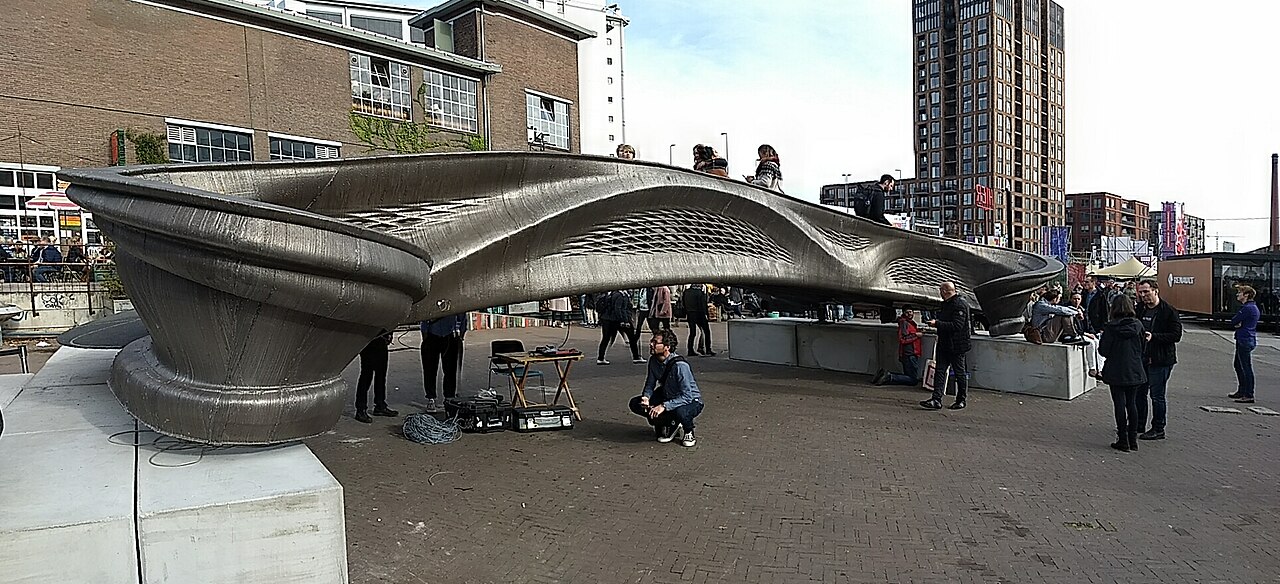
On 30 September 2026, Amsterdam-based MX3D announced that it had received a DNV Certificate of Qualification at Additive Manufacturing Criticality 3, known as AMC3. It is the most stringent level in DNV's additive manufacturing scheme, and the certificate covers MX3D's wire-arc additive manufacturing (WAAM) facility. DNV's own representative describes MX3D as the first company anywhere to reach that level for DED-Arc/WAAM technology.
This is not a desktop-printing story, and nobody reading this will be buying a certified WAAM cell for the garage. But certification news like this tends to shape which metal additive processes get trusted with real structural work, and that eventually changes what the wider ecosystem builds, funds and supports.
What was actually certified
According to MX3D, the facility, the software and the WAAM processes were all audited for their suitability to produce critical, high-load structural components. The process involved testing, material validation and quality checks on MX3D's robotic additive manufacturing systems and its MetalXL software.
That scope matters. Qualification schemes for load-bearing parts are rarely satisfied by showing that a machine can print a good sample. A facility-level qualification asks whether the whole production chain, including the software that drives the process, is controlled well enough to repeat the result. Including MetalXL in the audit suggests the toolchain was treated as part of the thing being qualified, not as an accessory to it.
The certificate was issued under DNV-ST-B203. According to 3D Printing Industry's report, the Certificate of Qualification applies to metal parts in the maritime, defense and energy sectors.
What AMC3 means
MX3D describes AMC3 as the most stringent DNV certification level, and 3D Printing Industry calls it the highest level in DNV's additive manufacturing certification. MX3D's release frames it around critical, high-load structural applications "where failure is not an option," which is why its description centers on those structures rather than general-purpose parts.
The wording of the claim deserves precision. The statement that MX3D is the first is not MX3D's marketing gloss alone. Dr. Sastry Kandukuri, Global Practice Lead on Additive Manufacturing at the DNV Technology Centre in Oslo, said MX3D is "the first company globally to achieve DNV certification at AMC 3 level for DED-Arc/WAAM technology." That is a narrow claim, limited to one criticality level and one process family, and it comes from the certifying body. Readers should keep it at that scope: it does not say WAAM as a category is now certified, and it does not say that other additive processes lack comparable credentials.
MX3D chief executive Gijs van der Velden called the certification "a monumental milestone for MX3D and the entire WAAM industry." That is a company executive speaking about his own company, and it should be read as such. The more informative statement is the certifier's.
The competitive pitch: forging and casting
MX3D positions WAAM as an alternative to forging and casting for heavy, large parts. That is the commercial argument the certificate is meant to support. Forged and cast components are the incumbent answer for big structural metal. A buyer in maritime, defense or energy who is asked to accept a printed substitute will likely want a third party to say the production process is under control, and a DNV certificate at the highest criticality tier is that kind of statement.
It is worth being careful about what the certificate does not establish. Neither source in this report publishes performance data, part-level test results, cost comparisons or lead times against forging and casting. The certificate shows that the facility, software and process passed an audit for critical high-load structures. Whether a given printed part beats a forged or cast equivalent on price or delivery remains a separate question that individual buyers will answer for individual parts.
Context: a long road for wire-arc qualification
3D Printing Industry places the announcement in a longer history. In 2017, DNV GL and Aurora Labs signed a framework agreement that was non-binding. In 2018, AML Technologies became the first company to obtain Lloyd's Register's additive manufacturing facility qualification for a wire-arc facility. The outlet contrasts MX3D's completed certificate with Aurora's framework agreement, which is a useful distinction: an agreement to cooperate on a path toward qualification is not the same as a facility holding a certificate.
Read together, the timeline shows a classification-society interest in metal additive qualification that stretches back close to a decade, and a gap between early agreements and a finished top-tier certificate. Note also that the Lloyd's Register qualification from 2018 and the DNV AMC3 certificate are different credentials from different bodies; the sources do not claim they are equivalent, and this report does not either.
What It Means for Makers
The direct impact on a hobbyist workshop is small. The practical significance is indirect, and there are a few things worth taking from it.
First, third-party certification looks increasingly important in metal additive manufacturing. Both sources tie wider use of metal AM in these industries to third-party qualification. Makers who work with service bureaus, or who hope to sell printed metal parts into regulated sectors, should expect to be asked for documentation of this kind.
Second, the scope of the audit is instructive. Software was in the audit boundary alongside the hardware. Anyone building a small production workflow, even in polymer, can borrow the lesson: repeatability comes from controlling the whole chain, from toolpath generation to the machine to the process record, rather than from one well-tuned printer.
Third, the claim is narrow and the sources are modest in what they give us. There is no published part data here, and readers should wait for specifics, such as which components MX3D will actually produce under the certificate, before drawing conclusions about the economics of WAAM against forging and casting.
What can be said now is plain. A WAAM facility has passed DNV's most stringent additive manufacturing audit, under DNV-ST-B203, for maritime, defense and energy parts, and DNV's representative says no company before it has reached that level for DED-Arc/WAAM. For a process that has spent years being described as promising, a certificate that a classification society will put its name on is a different kind of evidence.
