
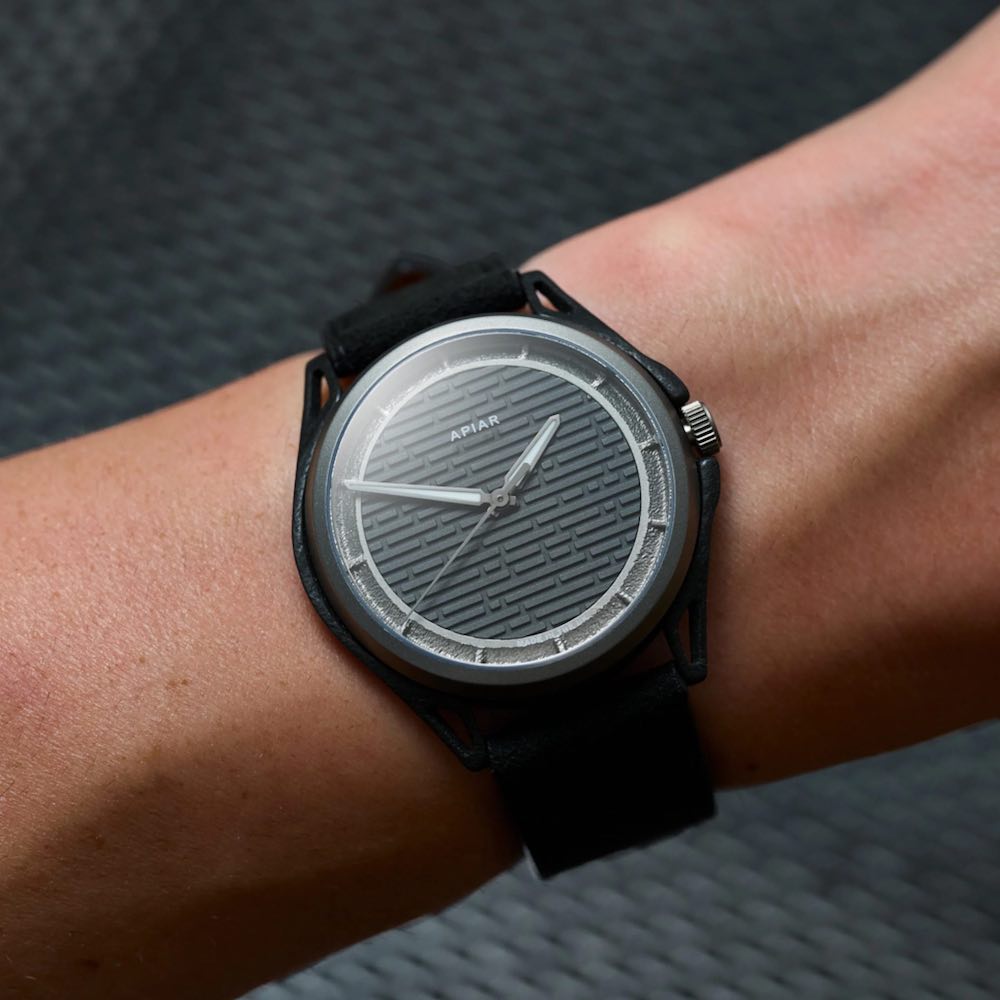
London watchmaker Apiar has added a fifth 3D-printed timepiece to its catalogue, and this one goes further than metal powder. According to a report by Tess Boissonneault at VoxelMatters published on 5 October, the new Carbon01 OG puts a carbon-fiber-reinforced PEEK outer case over a 3D-printed Grade 23 titanium core. Apiar says it is the first commercially available watch to use composite-based additive manufacturing. Prices start at $1,818.
The claim is narrow, and it comes from one place. As of this writing FilamentFeed has found only the VoxelMatters article covering the launch. We could not check the specifications or prices against a maker's product listing. Apiar's main site at apiar.co.uk does not mention the Carbon01 OG yet. Unless we say otherwise, the details below come from VoxelMatters.
A Layered Case, Built Two Ways
The Carbon01 OG splits the job between two processes. The midcase is 3D-printed Grade 23 titanium. VoxelMatters describes it as retaining the distinctive texture of laser powder bed fusion (LPBF) parts, so the surface still shows how the part was made. Around it sits a carbon-fiber PEEK composite outer case over the media-blasted titanium core.
That arrangement should interest anyone who has argued over whether a composite print can do structural work. VoxelMatters credits the CF-PEEK outer case with part of the watch's durability boost, and the titanium sits inside it. Whether the split reflects the limits of printed CF-PEEK or simply the look Apiar wanted is not something the available coverage explains. The published details do not name the printer, the process used for the composite shell, or how the two layers are joined.
The other parts are conventional. The dial is reportedly machined aluminum with a black anodized finish to match the color of the carbon fiber composite. A La Joux-Perret movement drives the watch, behind a sapphire crystal front with an anti-reflective coating. In other words, the printing is concentrated in the case, while the movement and crystal are bought in.
Where It Comes From
Apiar makes provenance a big part of its pitch, and VoxelMatters reports that the company publishes a manufacturing transparency sheet for the watch. According to that breakdown, the case, dial, strap and final assembly are British, as is some of the packaging. The movement is Swiss, the crystals and crowns are Japanese, and the hands come from India.
The company's homepage takes the same line. It describes additive manufacturing as a way to start with nothing and add only what is needed, and says the bulk of its components are built in Britain with everything assembled there. A transparency sheet is a useful habit. A buyer can see which parts are printed, which are machined and which are bought in, without having to infer any of it from marketing copy.
Pricing and the Additive Upgrade
The base Carbon01 OG costs $1,818. Apiar also offers what it calls an "additive upgrade" for $2,087. That package includes a signature SLS 3D-printed nylon watch case, a custom strap and a skeletonized titanium buckle. VoxelMatters says Apiar's website states the watch can only be ordered until the end of the month, after which the company will no longer make the OG edition. That makes it a limited ordering window rather than an open-ended production model, although the report does not give a production cap.
A Small Company Iterating in Public
Engineers Matt Oosthuizen and Sam White founded Apiar in 2022. The Carbon01 OG is its fifth 3D-printed watch and the first in what the company calls its Sports Series. VoxelMatters says the first product, the Invenire, arrived in 2024, followed by the ERB, the Gen1.0 and the Gen1.1. The collection links on Apiar's homepage list Carbon1.0, Gen1.1, Gen1.0 and ERB. The available sources do not say how Carbon1.0 relates to the new Carbon01 OG, so we will not guess.
Five models since a 2024 debut is a fast pace for a watch brand. A CF-PEEK outer case over printed titanium suggests the company is still trying out new material combinations rather than settling on one recipe.
What It Means for Makers
Most readers will not buy a $1,800 watch because of its case material. The design is still worth a look, for a few reasons.
Hybrid parts are a practical pattern. Combining a printed metal core with a printed composite shell is an approach makers can borrow at a much smaller scale and lower budget. Print the dimensionally critical part in the stiffest, most stable material you can get, and use the composite where looks, weight or feel matter more. Apiar's watch is a commercial example of mixing a printed metal and a printed composite in one case.
Leaving process marks visible is a design decision. Apiar's titanium midcase keeps the distinctive LPBF texture instead of being polished away. Makers who sand every layer line may want to note that a premium product is selling the opposite. If the surface is consistent, the marks of the process can become part of the look.
Treat "first" claims with care. "The first commercially available watch to use composite-based additive manufacturing" is a specific claim that is hard to check. It depends on how "commercially available" and "composite-based" are defined. We have not seen any independent verification of it, and we could not check it against a product page. Read it as the maker's framing, not an established fact.
Transparency sheets are worth copying. If you sell printed parts, whether on Etsy, through a small brand or as a consultancy, publishing which parts are printed, which are machined and where each comes from builds trust. Apiar shows that this level of disclosure can be part of the selling point.
Bottom Line
The Carbon01 OG puts a printed composite on the outside of a watch and a printed titanium structure inside it, with conventional parts doing the rest. The open questions are the ones FilamentFeed readers would care about most: which composite printing process Apiar used, and how the shell and core are joined. Until Apiar's product page or a second outlet fills in those gaps, the details rest on a single report.
