
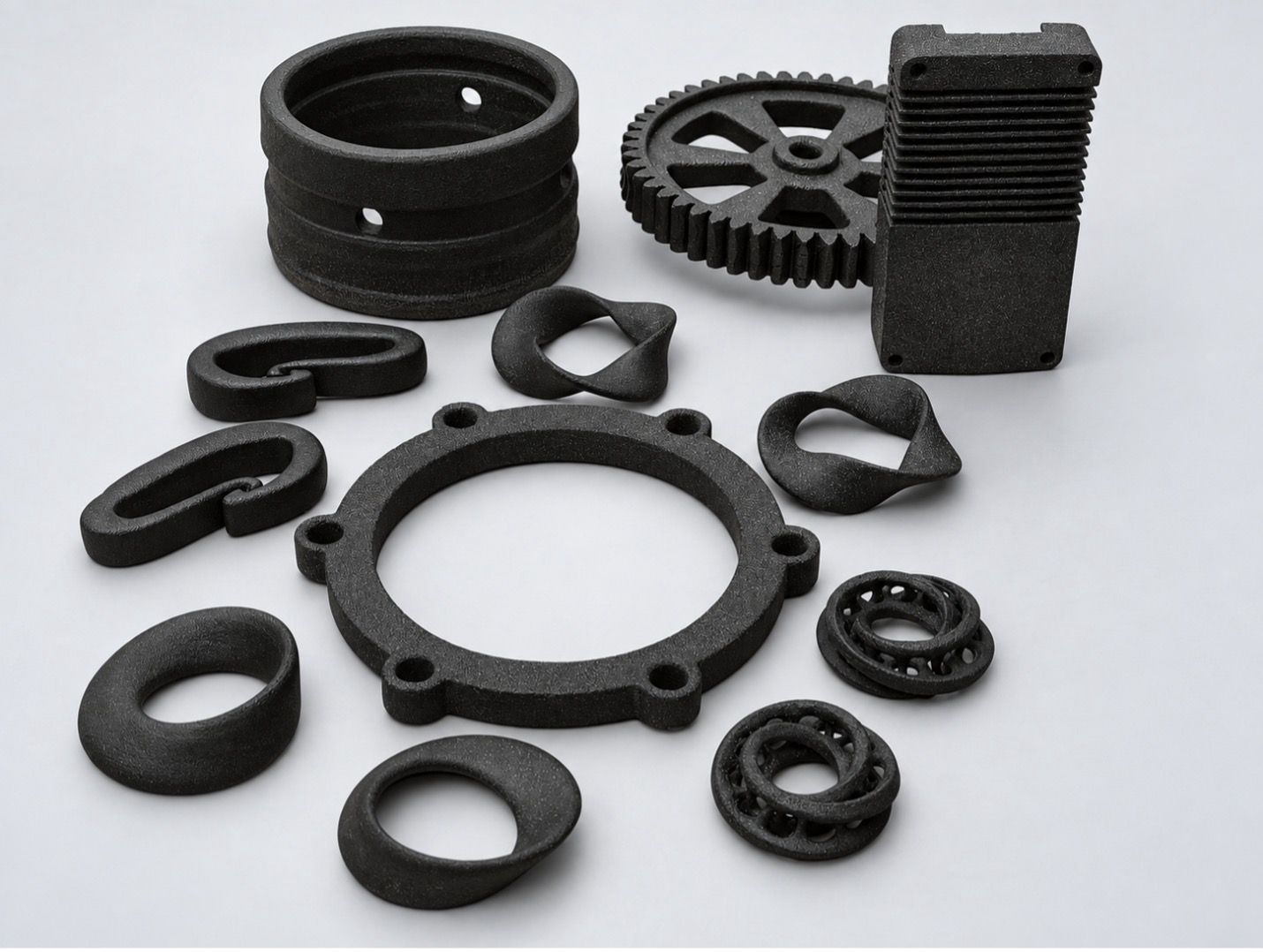
Polyetherimide has long been close to the top of the list of polymers people want to print and can't easily sinter. Three companies now say they have a workaround. According to a report from VoxelMatters, BlueSky Polymers, Insight Polymers & Compounding and Advanced Laser Materials (ALM) have developed xPEI. It is an amorphous, reactive polyetherimide offered as a reusable selective laser sintering (SLS) powder and as FDM filament. The material is built on the same backbone as Sabic's Ultem. The key difference is that it reaches the printer in a form designed to flow, and it is cured into its final high-temperature state only after the part is built.
The partners have not published a press release, datasheet or product page that we could read. BlueSky Polymers' website currently shows a "launching soon" placeholder, and the ALM and Insight homepages don't mention xPEI. Every technical claim below comes from the VoxelMatters report. None of it has been independently verified, and we have not seen any published mechanical or thermal data.
Why PEI and SLS Have Not Mixed
The obstacle is rheology. VoxelMatters reports that PEI has been unsuitable for SLS because of its high melt viscosity and limited interlayer diffusion. Laser sintering does not apply pressure to the powder. Particles have to soften, flow into each other and fuse during the short time the laser heats them. A polymer that stays thick when molten doesn't coalesce well. Polymer chains that don't spread across layer boundaries leave weak interfaces. With a high-performance amorphous resin like PEI, both problems show up together.
The same physics affects filament printing. FDM users who have run Ultem-type materials know that interlayer bonding, not the bulk properties of the polymer, usually limits part strength. The usual responses are heated enclosures, high chamber temperatures and careful process tuning, and they only partly close the gap.
The Reactive Trick
xPEI tackles the problem at the molecular level. The polymer is supplied as a reactive, lower-viscosity material that flows easily while it is being printed. It doesn't need to behave like a fully built-up high polymer until after printing. Once the part is printed, a controlled thermal cure takes the chemistry the rest of the way. VoxelMatters reports that this post-print cure raises the glass transition temperature and reduces part-to-part variability.
The approach separates processability from performance, which is the tradeoff that has always hurt high-temperature thermoplastics in additive manufacturing. The material can have low viscosity when it needs to flow and fuse. It gets its high-temperature properties later, in an oven, when no fusion is happening. The partners also say printed parts keep isotropic properties. If that holds up, it matters as much as the heat rating, because direction-dependent strength is the usual weak point of layer-built parts.
The other claims are broad. VoxelMatters lists low flammability, fluid stability and an "infinite" shelf life. The partners say xPEI offers the highest heat resistance, chemical resistance and tensile strength of any SLS thermoplastic. That is a strong claim, and it can't be checked without numbers, test methods or third-party data. Treat it as a claim, not a specification, until a datasheet appears.
Who Is Involved
BlueSky Polymers is a spin-out from UNC Chapel Hill. Its chief technology officer, Theo Dingemans, is a UNC professor who presented the work at the ICAM forum on September 28. xPEI belongs to BlueSky's REAPER portfolio of reactive polymers, which also includes a reactive polyamide-imide called xPAI. That suggests the curing approach is meant as a platform for several high-temperature polymers, not a single product.
Insight Polymers & Compounding handles material production. The company is based in Northeast Tennessee and was founded by A.J. Pasquale and Jeremy Lizotte. Its website describes it as a custom compounder offering standard and custom compounded materials. VoxelMatters reports that Insight is already producing xPEI in multi-kilogram quantities. That is well past lab-bench scale, but it is still pilot volume, not commodity supply.
ALM handled the powder. The Temple, Texas company was founded in 2004 and is a subsidiary of the EOS Group. Its president is Donnie Vanelli. ALM's homepage describes the company as a supplier of laser sintering materials for powder-bed 3D printing, with a systematic, tailored approach to identifying or developing materials. According to VoxelMatters, ALM prepared the xPEI polymer for SLS printing and printed the initial parts. Vanelli pointed to ALM's scanning controls on EOS P series SLS systems as a good fit, and Dingemans says the chemistry is meant for existing SLS and FDM systems, not a dedicated new printer.
Target Applications
Matt Torosian, sales and market development manager at Insight Polymers, listed the intended uses in the VoxelMatters report:
- Aviation ducting
- Drone and missile skins
- Fluid handling in data centers
- Semiconductor test sockets
- Sterilizable surgical tools
These are areas where PEI's combination of heat resistance, flame behavior and chemical resistance already makes it attractive. Additive manufacturing could help most in those that need complex internal geometry, such as ducting and fluid manifolds, or low-volume custom parts like test sockets. Those are also highly qualified, conservative markets. Any new material entering them will face long certification cycles, however good its first parts look.
What It Means for Makers
In the near term, xPEI is not a spool you'll find on a hobby retailer's shelf. The three companies say they are in prospective conversations and looking for early pilot customers. ALM's initial parts were printed on industrial SLS equipment, and the only production figure available is in kilograms. The FDM filament version is the part most relevant to advanced desktop and prosumer users. But nothing has been published about required hotend or chamber temperatures, curing schedules or the ovens needed for the post-print cure.
That cure step is the main practical question. A part that needs a controlled thermal cycle after printing has a production workflow closer to a thermoset's than to a print-and-done thermoplastic's. Shops will want to know how long the cure takes, how much the part shrinks or distorts during it, and whether supports or fixtures are needed to hold geometry. None of that has been published yet.
The broader idea deserves attention anyway. Most efforts to make high-temperature polymers printable have relied on hotter machines and tighter process control. xPEI changes the material so that it is easy to process first and gets its full properties later. If the isotropy and cure-stability claims hold up under independent testing, the approach could reach beyond PEI. BlueSky's xPAI is already in the same portfolio. For now, makers should watch for a real datasheet before making plans around it.
