
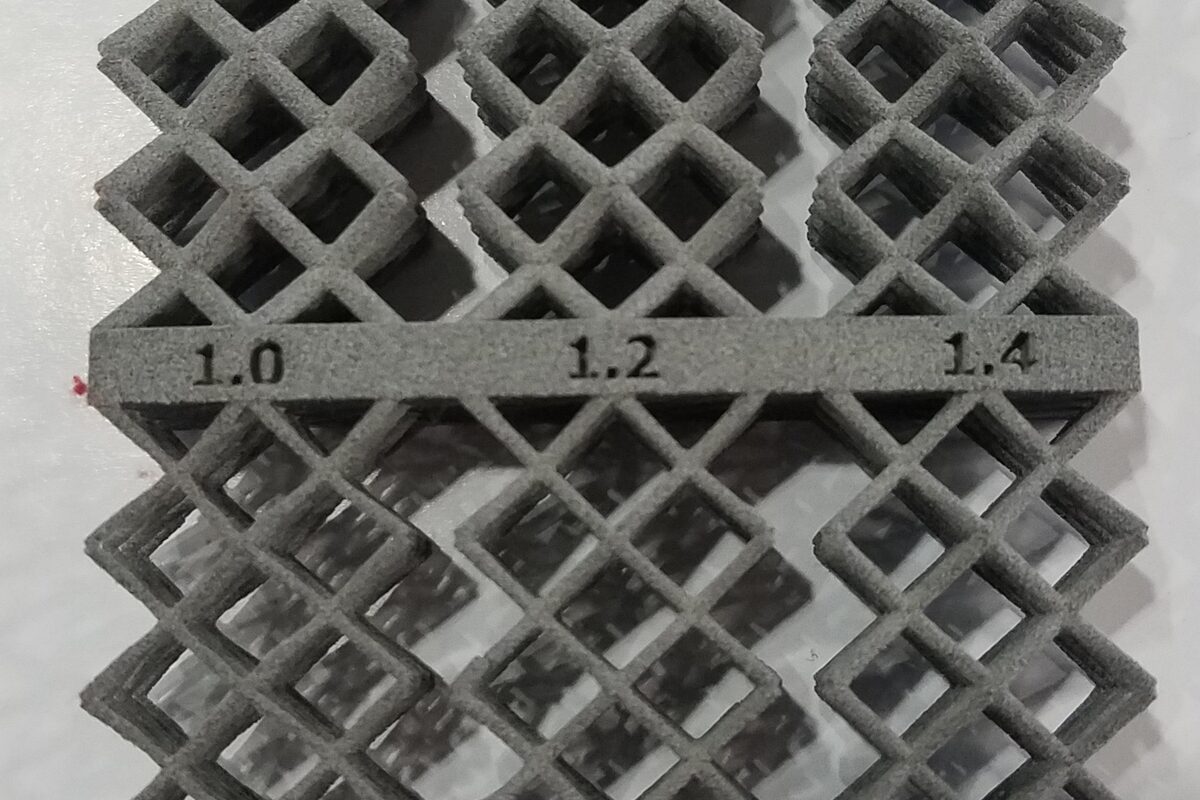
A 3D-printed lattice usually tells you nothing about its own health until it breaks. A team from the UK and Australia has now built one that does, according to a University of Glasgow news release. Engineers at Glasgow and the University of Sydney printed resin lattices loaded with carbon nanotubes, then used electrical impedance tomography (EIT), a technique borrowed from hospital imaging, to reconstruct a live map of where the material was conducting and where it was not. As the specimens were stretched toward failure, the map showed the damage.
The researchers say it is believed to be the first reported use of in situ EIT to monitor damage in 3D-printed architected metamaterials. The paper, "Full-Field Damage Monitoring in Architected Lattices Using In situ Electrical Impedance Tomography," was published on 28 September 2026 as an Early View article in Advanced Functional Materials.
How the trick works
The material has two ingredients that matter. The first is the geometry: plastic lattices with precisely arranged struts, the sort of architected structure that additive manufacturing makes easy and conventional machining makes painful. According to 3D Printing Industry, the specimens were DLP-printed resin lattices with carbon nanotubes mixed in.
The second ingredient is the nanotubes. Carbon nanotubes make an otherwise insulating resin electrically conductive. That is the whole premise: if the printed part carries current, then anything that interrupts the current path, such as a crack through a strut, changes how the part conducts.
EIT is the readout. Electrodes are placed on the outside of the specimen, and current is passed through them while voltage differences are measured. From those boundary measurements, the technique reconstructs a map of conductivity across the whole body, not just at the electrodes. In medicine, EIT is used to monitor lung function in hospital patients. The Glasgow release describes the specimens being stretched to failure while an algorithm turned the voltage changes into real-time maps. The 3D Printing Industry report says the lattices measured 48 by 60 mm and carried 16 electrodes attached by hand; the Glasgow release gives a 48 mm width for the rectangular specimens.
Prof. Shanmugam Kumar, who leads Glasgow's SM2AM Lab, compares the output to an MRI scan. The comparison is apt in one sense: the sensing does not rely on a handful of point sensors, but on imaging the interior from the outside. Both sources say the maps also picked up damage occurring away from the electrodes.
What the maps showed
The headline number is spatial resolution. The Glasgow release says damage was localized to within approximately one strut of its actual location. The 3D Printing Industry report states it in lattice terms: each fracture was located to within one unit cell, about 12 mm.
The team also built tiny cracks into some struts deliberately and tracked them as they spread outwards under increasing strain. That matters for validation, because a known flaw gives you ground truth to compare the reconstruction against. The Glasgow release adds that the results were checked against direct observation of the structures. The maps also showed damage building up before failure, which the Glasgow release identifies as a possible basis for an early-warning system. A part that reports growing damage before it separates is a different engineering proposition from one that simply fails.
The work builds on years of earlier output from the SM2AM Lab, including a 2024 modelling framework that predicted how the conductivity of lattice materials changes when stretched or compressed. The release calls that approach relatively complex, and says the team turned to EIT to monitor conductivity across the whole structure instead of at individual points.
Reading the claim carefully
A few points are worth keeping straight. The resolution is coarse: one unit cell, about 12 mm, on specimens measuring 48 mm across. It tells you which region of the lattice has failed, not the geometry of a crack. 3D Printing Industry adds that two fractures closer than about two to three unit cells appear as a single damage zone. The two sources also describe localization slightly differently, one in struts and one in unit cells, and we have not seen the paper itself, so we are reporting both as given.
The tests described were tensile: specimens stretched to failure. According to 3D Printing Industry, all tests so far used flat 2D lattices pulled in slow tension. The sources do not describe fatigue cycling, impact, temperature swings, or what happens to the sensing as the material ages. They also do not report printing parameters, nanotube loading, or the resin used, so nothing here lets a reader reproduce the material at a bench. Those details sit in the paper, which we have not reviewed.
There is also a trade-off. 3D Printing Industry reports that the lattice design lets the brittle resin stretch further before breaking but lowers its strain sensitivity, measured as gauge factor, from 4.2 in the solid composite to 1.02.
The authors, per the Glasgow release, are Akash Deep and Prof. Andrew McBride of Glasgow, Dr Andrea Samore and Prof. Alistair McEwan of Sydney, and Prof. Kumar. Funding came from the University of Sydney-University of Glasgow Ignition Grants and a Vaibhav Fellowship awarded to Kumar by the Indian National Academy of Engineering and India's Department of Science & Technology.
What It Means for Makers
This is lab research, not a filament you can buy. But it points at something makers who print functional lattices should watch.
First, the sensing comes from the print material and the geometry, not from bolted-on gauges. The monitoring is in the part itself. For anyone printing energy-absorbing lattices, brackets or lightweight structural infill-style parts, the idea of a part that reports where it is cracking is appealing, particularly for parts that are hard to inspect once installed.
Second, the process used here is DLP resin printing, a route already familiar to many makers, with a conductive filler mixed in. The practical hurdles are the usual ones for filled resins, but the sources do not discuss them, and we will not guess. What the work establishes is that the approach functions on printed lattices at the scale tested.
Third, the potential uses named in the Glasgow release are medical implants, aircraft parts and car bodies. Those are research aspirations, not products, and no certification or deployment is claimed in the sources. Kumar himself says further work is needed to develop and scale the technology for practical applications.
The takeaway is narrow but real. Pairing a conductive printed lattice with an imaging technique from medicine gave the team a way to see damage forming inside a 3D-printed structure, as it happened, to roughly a unit cell. Whether it scales to larger parts, other geometries or real service loads is the open question, and the answer will come from follow-up work rather than from this paper alone.
