
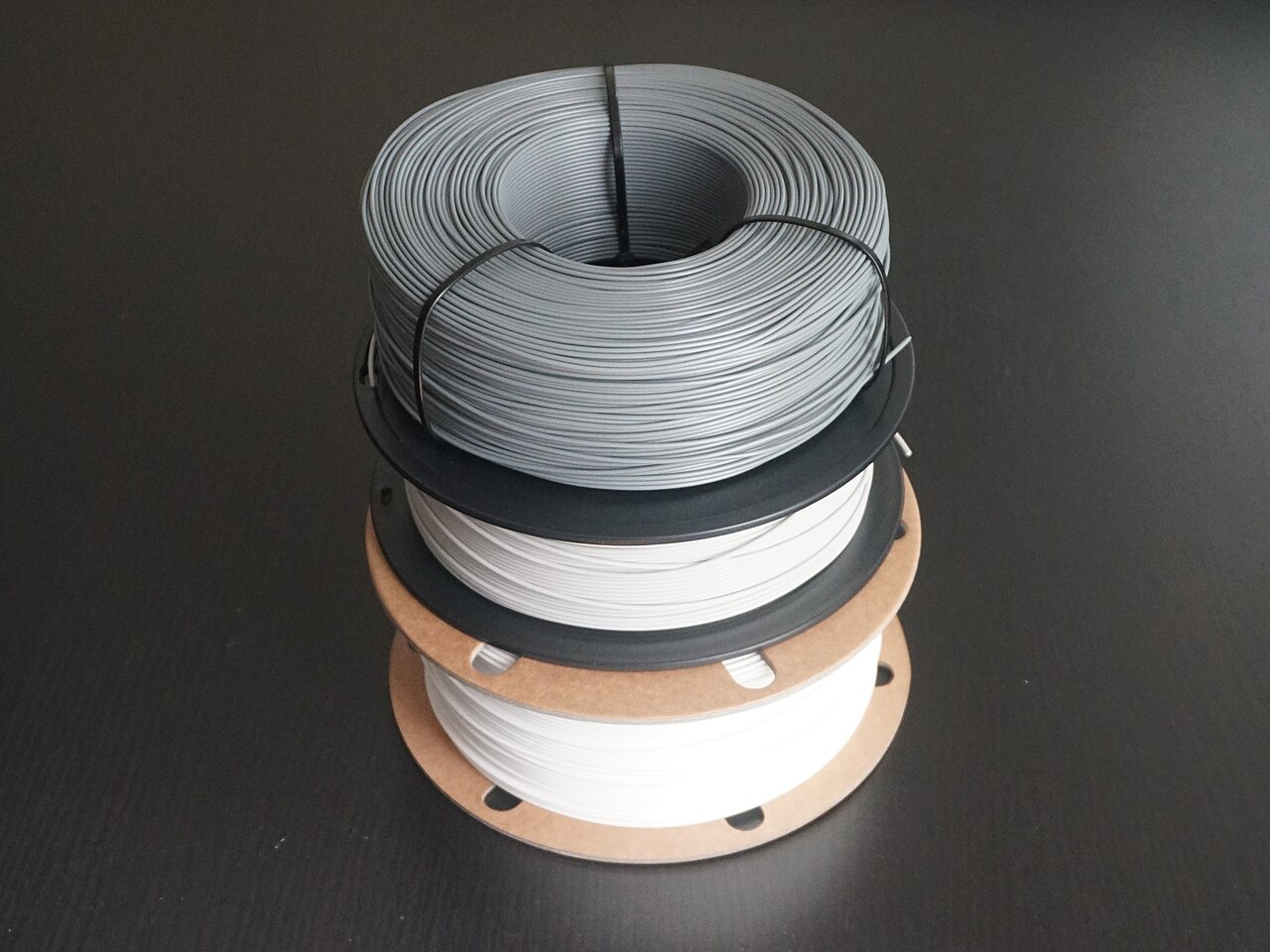
Every FFF user eventually learns the same lesson: a printed part is only as strong as the bond between its layers. The Army Research Laboratory thinks it has a practical answer to that weakness, and it wants the answer on a spool. In a newsroom post dated November 24 titled "ARL-industry partnership delivers stronger 3D-printed parts for Soldiers," the U.S. Army DEVCOM Army Research Laboratory (ARL) describes a patented thermoplastic filament that combines two polymers in a single strand. According to coverage of the announcement, the lab says this material gives printed parts twice the interlayer strength of parts made with conventional filament, and it runs in a regular 3D printer. ARL is now working with Texas-based ZYLtech Engineering to get the material to commercial production rates.
ARL's full article page was not accessible when we checked; the newsroom listing confirms the headline and date. The technical and program details below come from VoxelMatters' report on the announcement, which quotes the researchers involved.
Two Polymers, Two Jobs
The idea behind the filament is a division of labor. A single-material filament has to do two things that work against each other. It has to stay put once deposited, holding the geometry the slicer intended, and it has to fuse well with the layer beneath it. A polymer that flows easily enough to bond aggressively tends to sag. One that holds its shape tends to form a weaker weld line. VoxelMatters notes that most commercial filaments contain a single polymer, which can leave weak bonds between layers and produce parts too brittle for extended battlefield use.
ARL's filament splits those jobs between two polymers with different melting points, packed into one strand. One polymer maintains geometric stability. The other provides strong bonding between layers. Eric Wetzel, an ARL mechanical engineer and one of the filament's inventors, is quoted saying that simply replacing the filament in a regular 3D printer with the patented dual-material filament produces a part with twice as much interlayer strength. In practice that means a drop-in swap, with stronger parts along the axis where FFF prints usually fail.
There is a second, optional stage. Wetzel says that heating a finished part in an oven within a specific temperature range gives even higher strength without changing the part's dimensions or 3D geometry. That last point matters. Annealing ordinary single-material prints to improve layer adhesion can bring warping, and the 2023 paper discussed below documents exactly that in conventional samples at higher annealing temperatures. A filament in which one component holds the shape while the other consolidates is a plausible way around that trade-off, though that reading is ours, not ARL's. The published coverage does not give the annealing temperatures or the strength figures after annealing, so we can't say how much more strength the oven step adds.
Where It Came From
This work has a visible research lineage. In 2023, Scientific Reports published "Accelerated annealing of FFF thermoplastics via an improved core-shell filament" (Sci Rep 13:13538), a study whose authors include ARL's Ryan Dunn and Eric Wetzel, with University of Massachusetts Lowell co-authors. That paper took a core-shell, dual-material approach to the same problem: poor interlayer adhesion in FFF parts, and how to anneal them faster. It describes earlier work with a polycarbonate core and ABS shell that provided thermo-structural stability during annealing but was limited to relatively low temperatures and long annealing times, and it then uses a higher-glass-transition polycarbonate copolymer with ABS to improve on that.
The 2023 paper is best treated as a precursor, not a spec sheet for the new product. The announcement describes a two-polymer filament with two different melting points. It does not confirm that the material ZYLtech is scaling uses the same polymer pair or geometry as the published study. The two efforts clearly share a research thread, but anyone looking for exact chemistry should not assume the 2023 formulation is what will ship.
From Lab Bench to Extrusion Line
Making a dual-material strand at volume is a manufacturing problem as much as a materials one. According to the report, after several years of research into cutting production costs, ARL found that ZYLtech was one of the only domestic vendors with the specialized extrusion line the process requires, one that feeds multiple extruders into a single filament die. Wetzel is the source for that account.
The partnership runs under a Cooperative Research and Development Agreement (CRADA) that began in 2025. The split of responsibilities is straightforward. ARL supplies expertise in material selection, the arrangement of the material within the filament cross-section, and die design. ZYLtech provides the extrusion equipment and know-how to approach commercial rates. Parts from several pilot runs went to Army units for field evaluation, and Wetzel said the team is continuing research to raise filament quality at the highest production rates. That last detail is a useful signal: the material is not yet making full-speed production runs at its target quality.
Dimitra Stratis-Cullum, ARL's Chief Scientist, is also quoted in the coverage. She says that much of ARL's research is so unconventional that the infrastructure needed to scale it often doesn't exist in industry yet, and that ARL's researchers deal with that by collaborating with external partners to help them build it. This project is a concrete example of that approach.
Field Testing
The Army's interest is clear enough: a unit that can print a usable replacement part in the field doesn't have to wait on a supply chain. ARL first evaluated the material with the DEVCOM Ground Vehicle Systems Center (GVSC). Matthew Ludkey, a mechanical engineer and lab manager there, said the filament was incredibly easy to run through the standard-issue printers used by Soldiers in the field, and that thanks to its improved structural performance GVSC was able to test and approve 3D printed replacement parts using expeditionary printing capabilities that were previously only printable on industrial-style 3D printers.
The more vivid test involved quadcopters. Printed quadcopter bodies were sent to the Army's 25th Infantry Division in Hawaii, where soldiers fitted motors and flew them in durability trials. Per the report, the ARL bodies outperformed conventional-filament versions and did not break when stomped on. It's an informal test, and no numbers were published, but it speaks to a failure mode familiar to anyone who prints drone frames: layers separating under impact.
What It Means for Makers
For anyone who prints functional parts, such as brackets, enclosures, jigs or drone frames, the Z axis is the weak link, and most of the usual fixes involve compromises. You can reorient the part and give up surface quality or add supports. You can raise nozzle temperature and lose detail. You can switch to an engineering polymer that needs an enclosure and a hotter hotend. ARL's claim is attractive because it targets the problem at the filament level and says it works in a regular printer.
Several caveats apply. The available coverage doesn't name the polymers, list print temperatures, or say how strength was measured, so "twice the interlayer strength" has to be taken as the lab's headline figure until test data is published. There is no announced retail product, price, or release date. ZYLtech is scaling production under a research agreement, and pilot material has gone to Army units, not to consumers. Whether, when and in what form a civilian spool appears is unknown.
The dimension-stable annealing step is the detail to watch. If it holds up outside the lab, makers could print parts on a normal machine and then strengthen them in an oven without redoing the tolerances. That would be a real change in how functional FFF parts get made. Until the material is actually for sale, it's a promising result from a credible lab with a production partner already lined up.
Sources
- DEVCOM ARL News: "ARL-industry partnership delivers stronger 3D-printed parts for Soldiers" (Nov. 24, 2026; listing page)
- VoxelMatters: "U.S. Army lab's dual-polymer filament doubles interlayer strength" (Nov. 25, 2026)
- Scientific Reports: "Accelerated annealing of FFF thermoplastics via an improved core-shell filament" (2023)
