
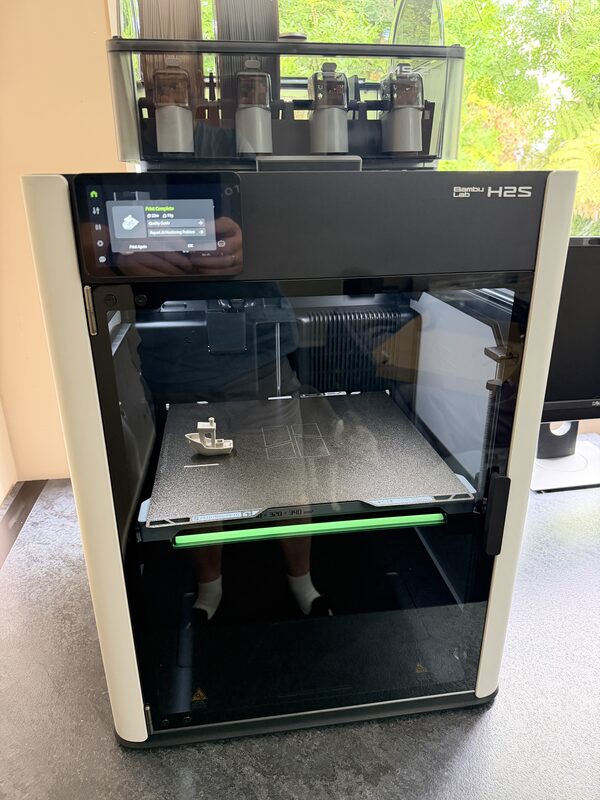
Fourteen desktop 3D printers just did something no CNC mill or fiberglass mold shop could pull off on a reasonable timeline: they built five nine-meter-long dinosaurs from scratch. As reported by 3DPrint.com, a fleet of Bambu Lab machines spent seven straight weeks printing glass-fiber-reinforced ABS (ABS-GF) components for artist Jay Jay Burridge's Megalosaurus sculptures, now standing in the gardens of Blenheim Palace as the centerpiece of the exhibition "Dinosaurs Are Forever."
It's a genuinely odd pairing on paper — a UNESCO World Heritage estate best known as Winston Churchill's birthplace, now hosting a herd of prehistoric predators built on machines that most makers associate with benchy prints and cosplay armor. But the project is a useful data point for anyone wondering how far consumer-grade FDM hardware has come when it's deployed at industrial scale rather than one printer at a time.
The Build: Fourteen Printers, Seven Weeks, One Very Old Animal
The sculptures depict Megalosaurus, which holds a specific distinction in the history of science: it was the first dinosaur ever formally named, described by geologist William Buckland in 1824 — nearly two decades before the term "Dinosauria" itself was introduced, in 1842. That's the framing device behind the exhibition's title, and it's also why the project leaned on a paleontologist rather than just a sculptor. Burridge, who works under the studio name Future Fossils, collaborated with Dr. Matt Dempsey — a musculoskeletal biologist, vertebrate paleontologist, and scientific illustrator who completed his PhD with the University of Liverpool and London's Natural History Museum — to get the anatomy right, while the additive manufacturing side of the build was handled by Gerard Shields of Printpool, a UK additive manufacturing firm that served as the project's AM production partner.
Splitting a nine-meter skeleton sculpture across fourteen desktop-class machines is itself the interesting engineering story here, even if the source material doesn't spell out every detail of the workflow. Getting five of these figures out the door in seven weeks means a production pipeline that looks less like a hobbyist's single-printer queue and more like a print farm: parallel machines running near-continuously, presumably churning through a segmented model where each dinosaur was broken into printer-bed-sized sections that had to be joined and finished into a coherent full-scale skeleton. The finished bones were assembled at Future Fossils' own workshop, which is the same segment-and-assemble logic belt printers and large-format shops use for oversized props and architectural models, just executed at a scale — five nine-meter creatures — that most farms never attempt.
Material choice tells its own story. ABS-GF — ABS reinforced with chopped glass fiber — trades some of standard ABS's toughness and layer adhesion characteristics for meaningfully higher stiffness and dimensional stability, which matters enormously when a part has to hold its shape as an outdoor sculpture rather than sit on a shelf. Glass-filled ABS is also more abrasive on hotends and typically wants a hardened nozzle to avoid rapid wear, plus the usual ABS demands: an enclosure, controlled cooling, and attention to warping on a print this large and this outdoors-bound. None of that is exotic to anyone who's run reinforced filaments before, but running it across fourteen machines simultaneously, at a scale meant to survive months of British weather in a public garden, is a different proposition than a single reinforced-nylon bracket.
What It Means for Makers
The headline number worth sitting with is fourteen. Not one printer, not a boutique large-format industrial rig, but a coordinated fleet of the same class of desktop machine plenty of readers have in their own workshop or garage. That's the real signal in this story: the ceiling on what desktop FDM can produce isn't really the printer anymore, it's the production pipeline wrapped around it — slicing strategy, part segmentation, fleet management, material handling, and finishing labor. A single Bambu Lab printer builds parts measured in centimeters. Fourteen of them, run in parallel over seven weeks with a coordinated file-and-material pipeline, build parts measured in meters.
For makers running or considering a print farm, the practical takeaways are less about the dinosaurs and more about the logic behind them: reinforced filaments like ABS-GF earn their keep on large, structural, outdoor-facing prints where stiffness and shape retention matter more than raw impact toughness; segmenting oversized geometry across a fleet of standard-bed machines remains the most accessible route to large-format output without buying a purpose-built large-format printer; and a project like this lives or dies on assembly and finishing time as much as print time — joining, sanding, and painting nine-meter sculptures from small printed sections is its own substantial labor line that doesn't show up in a "seven weeks" headline number.
It's also a reminder that additive manufacturing keeps finding its way into fields — paleoart, museum installation, public sculpture — that have traditionally relied on fiberglass layup, foam carving, or armature-and-skin traditional sculpture techniques. Those methods aren't going away, but a fourteen-printer desktop fleet is now a credible alternative production path for a commission this size, on a timeline a traditional shop would struggle to match.
Seeing It in Person
The Megalosaurus sculptures are described as never-before-displayed and are installed in the Palace Gardens as part of "Dinosaurs Are Forever," which runs Monday, August 10 through Sunday, November 1, 2026. Access is included with a Blenheim Palace Annual Pass or a Park & Gardens ticket, putting it within reach of anyone visiting Oxfordshire this fall who wants to see what a fourteen-printer ABS-GF production run actually looks like at full scale — a rare chance to inspect large-format desktop-FDM output in a context built for exactly that kind of scrutiny.
Oxfordshire is fitting ground for the exhibition beyond the palace grounds themselves: the original Megalosaurus fossils that Buckland described in 1824 are still on public display at the Oxford University Museum of Natural History, a short drive from Blenheim, for anyone who wants to compare the 3D-printed reconstruction against the fossil record that inspired it. The region has kept turning up material since — a large set of dinosaur tracks was uncovered at Dewars Farm Quarry near Bicester, a separate find unrelated to the Blenheim exhibition but a reminder that Oxfordshire's Jurassic-era limestone still has more to give up. Between the original fossils, the more recent trackway, and now a fleet of desktop printers turning that fossil record into full-scale sculpture, the county offers an unusually complete before-and-after view of how a 166-million-year-old animal gets rebuilt for a modern audience.
