
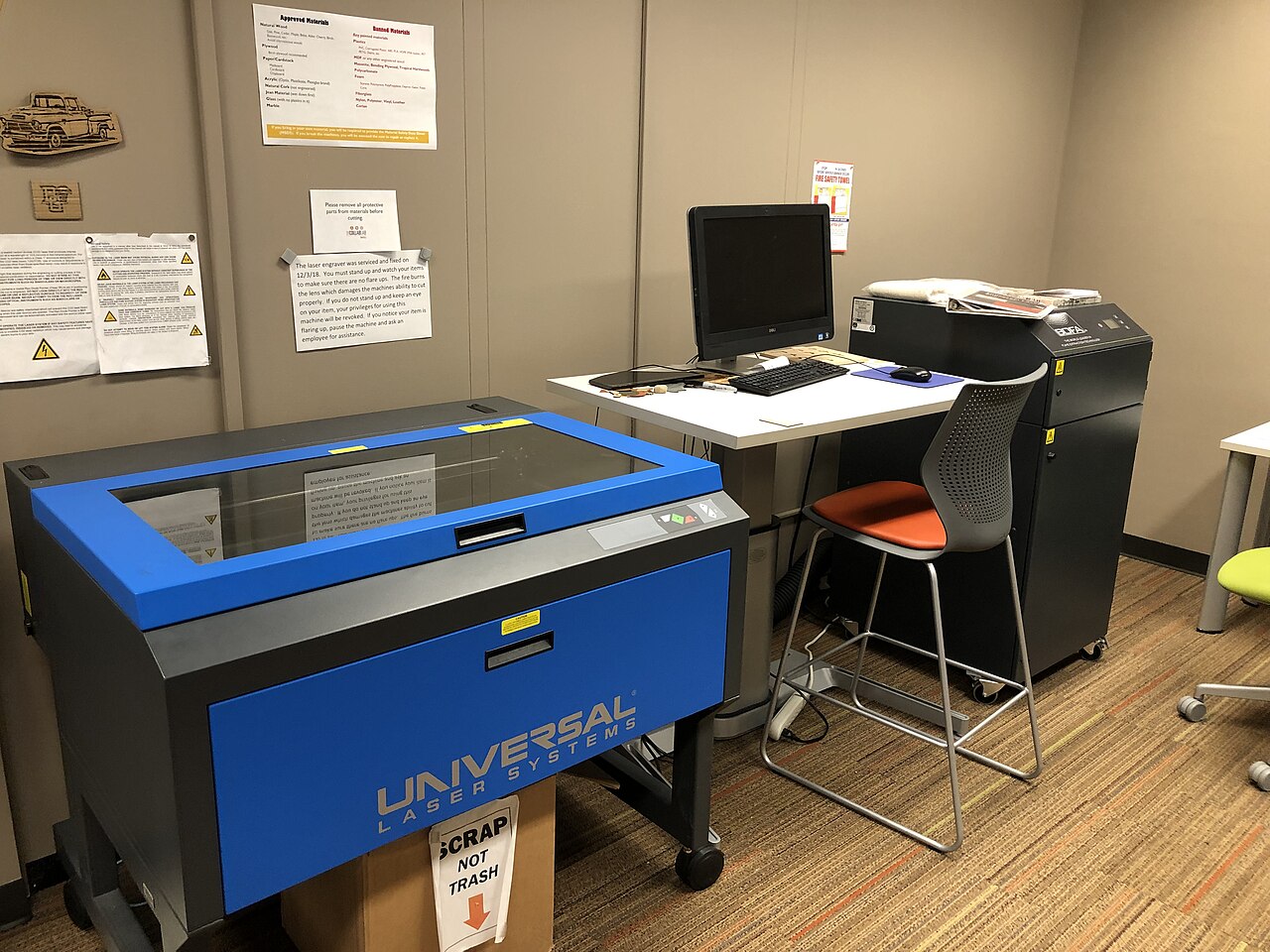
Bambu Lab, the company that reshaped desktop 3D printing with the X1 and P1 series, has opened pre-orders for the R1, a 55W CO2 laser cutter and engraver starting at $2,499. It's the company's first standalone hardware product that isn't a 3D printer, and it lands squarely in territory already staked out by xTool and Glowforge.
The R1's official store listing bills it plainly: "Meet Bambu Lab R1: 55W CO₂ Laser. Big Job. Light Work." There's no ambiguity about what this is or who it's aimed at — a 55-watt CO2 tube puts the R1 well above hobby-grade diode lasers and into the power class that serious sign makers, small-batch fabricators, and laser-cutting studios actually use for acrylic, wood, leather, and other non-metal stock.
What's in the Box, and What It Costs
Pre-orders opened September 22, 2026, according to a report from The Crafty Catsman, which laid out three configurations. The base unit runs $2,499. A "Long Material Bundle" — presumably adding pass-through or extended-bed hardware for oversized stock — comes in at $3,289. The top-tier "Long Material & Rotary Bundle," which adds a rotary attachment that rotates round objects for full 360-degree engraving on bottles, bowls, and cups, lists at $3,499. First units are estimated to ship in early November, giving Bambu Lab roughly six weeks between opening orders and getting hardware into customers' hands.
That pricing structure — a relatively accessible base price with bundles that unlock the features power users actually want — will look familiar to anyone who's shopped xTool's lineup. It's a strategy Bambu Lab has already run once, on 3D printers: hook buyers with a capable base machine, then let the upsells fund the accessories and consumables business.
A Crowded Field, Entered by a Heavyweight
The desktop laser market the R1 is stepping into isn't empty. xTool has spent the past several years building out a full stable of machines — the P2S, P3, and X1 among them — that span diode, CO2, and hybrid designs at price points from about $1,700 to nearly $7,000. Glowforge, meanwhile, runs its machines through a cloud-connected web app that requires an internet connection to start every job, and OMTech competes chiefly on what ships in the box — its Polar 2, at $3,699, bundles LightBurn software and a rotary attachment that are separate purchases on the R1.
The Crafty Catsman's coverage frames the R1 as a direct competitive response to all three, comparing it explicitly against the xTool P2S, P3, and X1 as well as Glowforge and OMTech. What isn't yet clear from the available material is how the R1 differentiates on the things that actually matter in day-to-day use: enclosure size and bed dimensions, air assist and fume extraction, camera-based material alignment, software (the R1 runs through Bambu Suite, a separate app from Bambu Studio, the 3D-printer slicer), and safety interlocks. Bambu Lab's store listing confirms the headline spec — 55W CO2 — but the deeper technical comparison against established players will have to wait for hands-on units in early November.
Why a Printer Company Is Building a Laser
The more interesting story here isn't the R1's spec sheet — it's the timing. Bambu Lab built its reputation, and its market share, on FDM printers that iterated fast on print speed, multi-material handling, and out-of-box reliability. That category has matured quickly. Print speeds have largely plateaued against what stepper motors, hotends, and slicer algorithms can practically deliver, multi-color AMS-style systems have become table stakes across the industry, and competitors from Creality to Anycubic to Elegoo have closed much of the gap that once made Bambu Lab machines feel like a generation ahead.
A company that wants to keep growing at printer-company speed has a few options: out-innovate an increasingly saturated FDM market, push harder into resin printing, or expand into adjacent categories that share a customer base but aren't yet as commoditized. Laser cutting fits that third path well. The buyer persona overlaps heavily — makers, small-batch entrepreneurs, sign shops, cosplay and prop builders — and the hardware, while different in principle, isn't a stretch for a company that already builds precision motion systems, enclosures, and companion software at scale.
It's also worth noting what the R1 signals about desktop digital fabrication generally: the "one machine per maker" era is giving way to "one ecosystem per maker." Bambu Lab's bet, implicit in the R1 launch, is that customers who trust the brand for one class of fabrication tool will extend that trust to a second, especially if the software and support experience feels unified. Whether that translates to laser-cutting expertise — thermal management, exhaust and ventilation requirements, and materials-specific power/speed tuning are genuinely different disciplines from FDM extrusion — is exactly what the first wave of real-world reviews will need to answer.
What It Means for Makers
For makers already in the Bambu Lab ecosystem, the R1 is an easy machine to be curious about: familiar branding, a base price that undercuts some established CO2 competitors, and the promise (unverified as of this writing) of a workflow that might tie into tools they already use. For makers currently shopping xTool, Glowforge, or OMTech, the R1 adds a serious new name to the comparison list, and competitive pressure on pricing or bundle contents from incumbents wouldn't be surprising in the weeks following the September 22 pre-order opening.
The practical advice for now is patience. Pre-order pricing and a product page don't answer the questions that determine whether a laser cutter is actually good to live with: cut quality at various material thicknesses, ventilation and safety design, software maturity, and long-term reliability of the tube and optics. With first shipments estimated for early November, real answers are roughly six weeks out. Buyers weighing a purchase against an xTool or Glowforge machine already on the market should watch for independent hands-on testing before committing, particularly at the $3,000-plus bundle tiers where the R1 is competing against mature, iterated products.
