
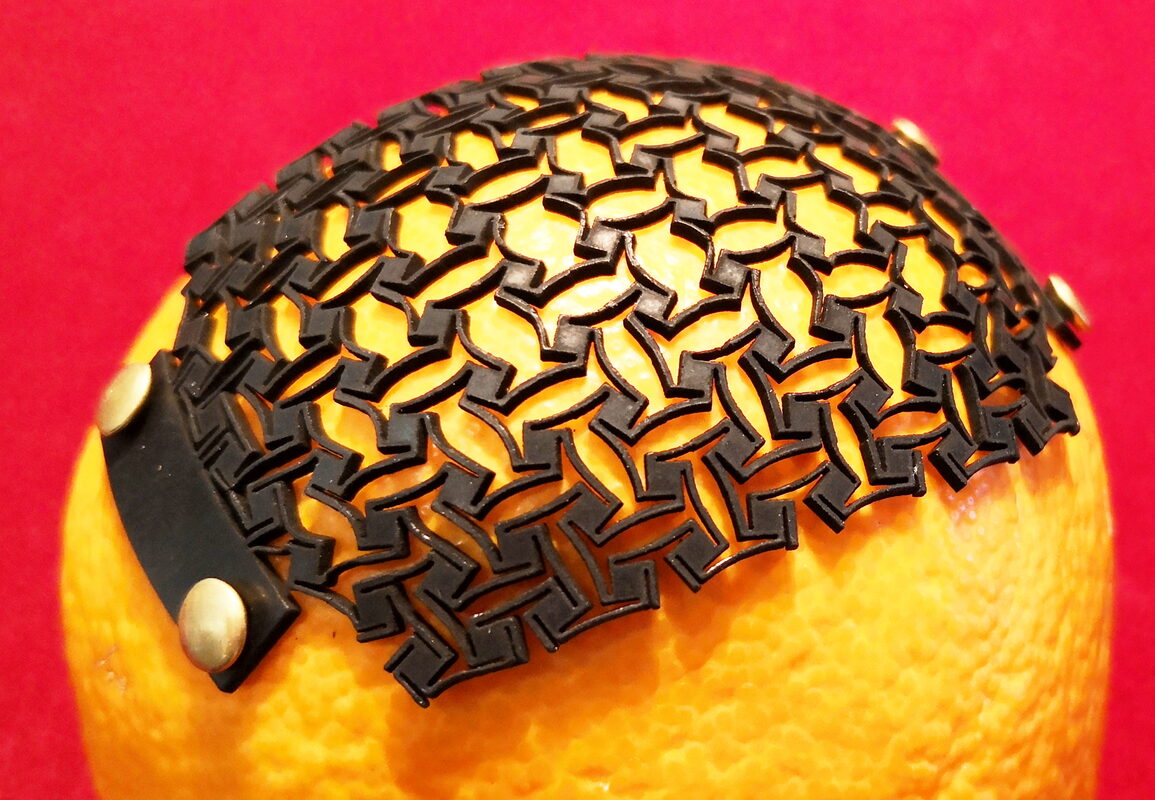
A team from Deakin University and Seoul National University of Science and Technology has 3D printed cylindrical lattice structures that change how stiff they feel and how they absorb energy purely by rearranging geometry, not by swapping materials — a technique detailed in a peer-reviewed paper published in Progress in Additive Manufacturing and reported on August 27 by 3DPrint.com. The parts, which the researchers call "meta-cylinders," are built entirely from a single flexible filament, yet stacking cylinders printed in different states — a stiff "closed" lattice and a softer, tension-opened "expanded" one — into one assembly makes it respond soft, then medium, then hard as a load builds, purely from geometry.
The work comes from Ali Zolfagharian and Moslem Mohammadi at Deakin, working with Eui-Hyun Kim and Keun Park at Seoul National University of Science and Technology. Rather than relying on multi-material printing or gradient infill to vary a part's mechanical response — the more familiar tricks in a maker's toolbox — the team leaned entirely on structural design: kirigami-inspired cuts combined with auxetic-triangle lattice geometry, wrapped around a cylindrical form and printed conformally rather than flat.
What Is a "Meta-Cylinder," Exactly?
Auxetic structures are already a familiar concept to anyone who has played with negative-Poisson's-ratio lattices in Fusion 360 or Grasshopper: instead of getting thinner when stretched, like ordinary materials, they get wider. Kirigami — the cut-and-fold cousin of origami — adds another axis of control by introducing slits that let a flat or curved sheet pop into a three-dimensional shape under load. The Deakin/SNUST team combined both ideas into a triangular lattice unit cell, then arrayed those cells around a cylinder rather than a flat plane.
The result is a structure that is "multistable" — a single cylinder has more than one stable geometric configuration and can snap between them. The as-printed closed state behaves as a comparatively stiff shell with pronounced snap-through events; pulled into its expanded state, the same cylinder becomes noticeably softer and more compliant, giving way smoothly instead of snapping. Because that swing comes entirely from geometry rather than chemistry, the same TPU material can be tuned — cylinder by cylinder, and by how they're combined — to behave like several different materials at once. The researchers describe this as using "morphology as a mechanical program" — the shape, not the chemistry, carries the mechanical instructions.
The Rotary Printing Setup
Printing a cylindrical lattice conformally — with extrusion paths that follow the curve of the cylinder rather than being built up in flat horizontal layers — isn't something a stock desktop FDM printer does natively. The team modified a Snapmaker 3-in-1 with a rotary module, effectively turning the build platform into a lathe-like axis so the print head lays material around a rotating cylindrical form instead of stacking flat layers on a stationary bed.
Getting there required stitching together several pieces of software that don't normally talk to each other. The meta-cylinder lattices were modeled parametrically in Rhino with the Grasshopper visual-scripting plugin — the standard combination for generative lattice and auxetic design — then sliced in Cura. Since standard slicer output assumes a flat Cartesian build volume, the team adjusted the resulting G-code so it would run in rotary mode instead. The material itself was ESUN's eTPU-95A, a flexible thermoplastic polyurethane, printed at 100% infill so that the lattice geometry — not porosity — was the only variable doing mechanical work.
That 100%-infill detail matters for anyone parsing the results: the softness and hardness differences the researchers measured aren't an infill trick. They come entirely from how the auxetic-triangle cells are shaped, angled, and connected, and from which combination of closed and expanded cylinders is engaged under load.
Programmable Collapse and Snap-Through Behavior
The most distinctive behavior the researchers report is a sequential "soft-medium-hard" collapse response, achieved by combining closed and expanded cylinders into one stacked assembly. The expanded, more compliant tube gives a soft initial response; a closed, stiffer tube engages later and sets the terminal load capacity. Combined with the snap-through transitions inherent to multistable auxetic geometry, that ordered engagement lets an assembly absorb energy in stages — a gentle cushioning phase followed by progressively stiffer resistance as the load increases.
That's a mechanical profile engineers spend a lot of effort chasing in impact-protection design, normally by layering foams of different densities or combining materials with different moduli. Here it emerges from one material and a geometry file, with staging set by how the cylinders are combined rather than by any material change.
What It Means for Makers
For most desktop printer owners, a rotary module is already familiar as a way to print onto cylindrical objects like bottles or tumblers, or to wrap continuous fiber around a mandrel. This work points to a more structural use case: printing lattice geometry directly around a cylindrical axis so the conformal shape and the mechanical lattice are the same feature, not decoration applied to a surface.
The practical appeal for makers and small engineering shops is that this approach sidesteps a persistent pain point in multi-material and functionally-graded printing — dual-extrusion or material-transition prints introduce their own failure modes at the material interface, and many flexible/rigid material combinations don't bond well to begin with. A single-material approach that varies stiffness through geometry alone — whether from one cylinder's snap-through states or from combining several into an assembly — removes that interface entirely. If a maker can get a rotary axis working reliably with custom G-code — the harder part, since off-the-shelf slicers don't support it out of the box — the design side (parametric auxetic cells in Grasshopper, or equivalent tools) is within reach of anyone comfortable with generative CAD.
The applications the researchers point to — stents, actuators, and shock absorbers — are the core, paper-backed use cases; 3DPrint.com's own coverage extends the idea further, floating roles like hydraulic pistons, damping components, and smart helmet liners. Either way, it's a useful shorthand for where "programmable stiffness via geometry" earns its keep: places where you want graded energy absorption but can't easily bond dissimilar materials at a small scale. It's still university-lab research rather than a shipping product, and the published paper is the place to look for the actual test data behind the "soft-medium-hard" claim. But the underlying idea — that geometry, printed conformally around a cylinder, can substitute for a material change — is within reach of the parametric-design-plus-modified-hardware projects this community already runs.
