
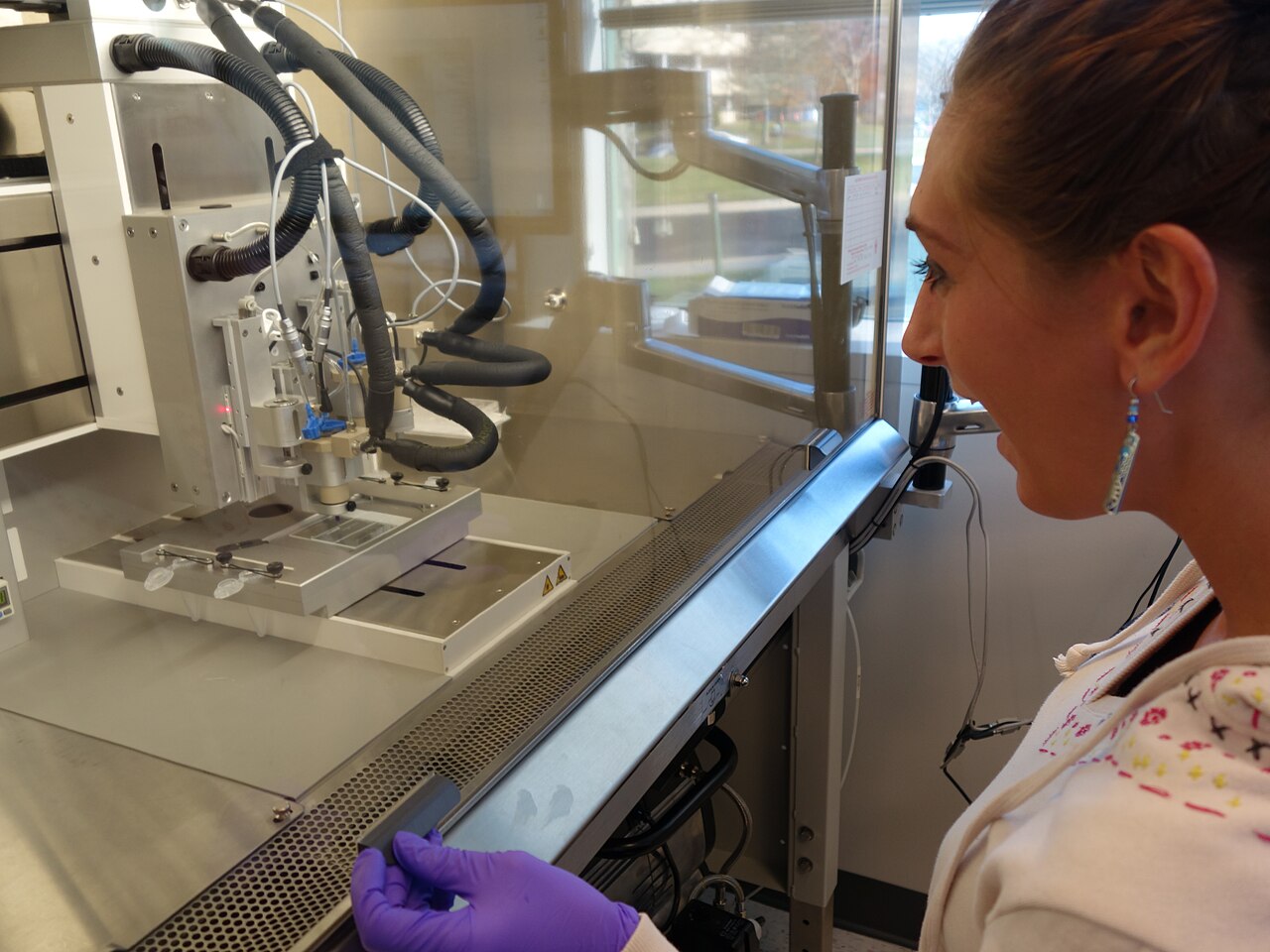
Turning a hobby printer into a lab instrument is an old maker pastime, but a team led from the University of Rochester has taken the idea somewhere unusually consequential. In a paper titled "3D Bioprinting of Engineered Living Materials in Support Slurries for Complex Free-Standing Structures", published online August 27, 2026, in ACS Applied Polymer Materials, the researchers describe converting a commercial FDM printer, an Ender 3, into a bioprinter that costs around $450. It prints structures made of living bacteria, and those bacteria were still alive at least 28 days later.
The comparison that makes the number matter: commercial bioprinters usually cost more than $100,000, according to Tom's Hardware, which covered the work. That is a gap of more than two orders of magnitude, and it sits squarely between a well-funded core facility and a lab, classroom or makerspace that has never had access to this kind of tool.
From Hotend to Syringe Pump
The hardware changes are the part most FilamentFeed readers will recognize. The team removed the printhead and replaced it with a syringe pump built from custom 3D-printed PETG parts. The pump holds a 10 mL glass Luer-lock syringe, and the parts were designed in SolidWorks, exported as STL files and sliced in Slic3r. In other words, the tool that prints living material was itself made with the ordinary workflow every maker already uses.
The printing parameters show just how far the machine has been pushed from its original job. Material goes through a 0.254 mm needle. The extrusion multiplier is cut down to 0.004, so the slicer's idea of how much material to push is scaled to a tiny fraction of what it would send for plastic. Flow runs at 2 mL per hour at a print speed of 23 mm/s. Anyone who has calibrated e-steps on an Ender will see what is going on here: the motion system stays the same, and only the material model is rescaled for a very different kind of extrusion.
The bio-ink is a mix of bacteria and alginate. On its own, a soft hydrogel loaded with cells would slump under its own weight long before it could form a tall shape. The researchers handle that by printing into a support bath instead of onto a bed.
Printing Into a Slurry
The paper describes two support baths made of microparticles, one agarose and one gelatin, each with its own role. According to Tom's Hardware, the slurries are enriched with calcium ions, which cross-link the alginate as it leaves the needle. The bath holds the extruded strand in place while it sets, then supports the structure as it builds up.
Which bath to use depends on what happens after printing. Agarose suits long-term incubation, and prints kept in it stayed viable for four weeks or more. Gelatin is the choice when the print needs to come out of the bath as a free-standing object. The abstract states that the bacteria survived at least 28 days with nutrient supplementation.
The geometry results are what make this more than a curiosity. The authors report aspect ratios above 8:1 and feature sizes as small as 260 µm. Those are tall, thin, detailed structures, the kind that would be impossible to build out of a cell-laden gel without something holding them up.
Retraction, of All Things
One finding will feel especially familiar to anyone who has fought stringing on a PETG print. The abstract reports that optimizing critical printing settings, including the ability of the bio-ink to retract during nonprint movements, reduced unwanted bacterial deposition by nearly two orders of magnitude, or roughly a hundredfold.
That matters more than it would in plastic. A stray strand of PLA is a cosmetic problem you can snip off, while stray deposits of engineered bacteria are unwanted living material in the print. The fix came from the same place a maker would look first, which is a good sign that the slicer-level controls on a consumer machine can be repurposed for this work.
The Material Science Underneath
The paper is not only about hardware. The researchers also studied how the printed engineered biofilms behave mechanically, and found that incubation conditions and the composition of the extracellular matrix significantly affected the mechanical properties of the printed constructs. They also report trade-offs between matrix production and mechanical integrity. Put plainly, getting the organisms to make more of their own structural material does not automatically give you a stronger part, and conditions have to be balanced against each other.
That is the central idea behind engineered living materials: the structure is not inert once printed. It changes as the organisms inside it grow and produce matrix, and its properties are partly set by how it is cared for afterward.
The author list includes Ram S. Gona and Marie Olland of the University of Rochester and Hongyi Cai of Cornell; Tom's Hardware credits the paper to Anne S. Meyer and colleagues. The abstract describes the system as a low-cost, open-source bioprinting platform.
What It Means for Makers
Nobody should read this as an invitation to start culturing engineered bacteria on the workbench. Working with living organisms carries handling and biosafety obligations that have nothing to do with printers, and this platform comes from a university lab for good reason.
What the work does show is that the price of entry for bioprinting research is far lower than the six-figure commercial machines suggest. The mechanical tasks involved, such as precise XYZ motion, controlled extrusion and well-planned travel moves, are things an ordinary consumer FDM frame already does well. What changes is the extruder, the material model in the slicer and the medium being printed into. For schools, community biolabs and smaller research groups, a design built from PETG parts, a standard glass syringe and open slicing software is the kind of thing that can be copied, adapted and improved.
It also points toward a future that could reach printer owners more directly. Tom's Hardware notes that the work could eventually lead to bacteria-based bioplastic filaments. That remains a possibility rather than a product, but it is a reasonable long-term direction: materials grown by organisms and processed on the same machines makers already own.
For now, the takeaway is simpler. The skills makers practice every day, such as tuning flow, chasing down stringing with retraction settings and designing printable mounts, turn out to be exactly the ones needed to build a working bioprinter. The Rochester team just applied them to a very different material.
