
Farsoon Technologies has unveiled the FS4X, a metal laser powder bed fusion (LPBF) platform that the company says was built around the demands of series production. Announced on November 12 ahead of Formnext, the machine pairs a 425 x 425 x 550 mm build envelope, roughly 99 litres, with either four 2,000 W lasers or six 1,000 W lasers. Five days later, Farsoon announced that Stark Future, the Barcelona-based electric motorcycle maker, had agreed to buy multiple FS4X systems for a series production line.
That order matters. Large multi-laser metal printers are not new, and spec sheets alone rarely tell you whether a machine belongs on a factory floor or in a prototyping lab. A vehicle manufacturer committing to several units for a production line is a stronger signal about where Farsoon is aiming than any figure on the datasheet.
Two Laser Configurations, One Envelope
The FS4X's most interesting design choice is that it offers two distinct optical configurations rather than a single fixed layout. One version carries four 2,000 W lasers; the other carries six 1,000 W lasers. VoxelMatters, in its coverage of the launch, describes both as fiber lasers.
Farsoon has not framed the choice in terms of specific applications in the material it published, so it would be speculative to say which configuration suits which job. The general trade-off is familiar to anyone who follows metal AM, though: fewer, higher-power sources versus more sources at lower power, each spread across the same build plate.
Farsoon also lists beam shaping among the FS4X's features, saying it broadens the available processing strategies. Beam shaping refers to altering the laser's spot profile rather than relying on a fixed, conventional beam, and it has become an increasingly common lever for productivity and process control in high-power LPBF. The company did not detail the specific beam profiles available.
With multiple lasers covering a shared field, calibration becomes a recurring operational headache: if the scan fields drift relative to each other, stitched regions show seams or dimensional errors. Farsoon says the FS4X performs automated in-situ scanner calibration and multi-laser alignment, which it describes as supporting optical consistency.
The Engineering Below the Lasers
Most of what Farsoon chose to emphasize is not optical at all. The announcement spends considerable attention on the mechanical and environmental systems that determine whether a machine produces consistent parts build after build.
On the gas side, the FS4X uses multi-layer gas flow, recirculating filtration, chamber pressure control and cooling, which Farsoon says help maintain stable processing conditions throughout the build.
Mechanically, Farsoon cites a one-piece machined build cylinder, which it says reduces potential powder-leak paths at joints, closed-loop Z-axis control using linear-encoder feedback, zero-point positioning, and a low-drag recoater. A linear encoder measures the platform's actual position rather than inferring it from motor steps, which bears directly on layer-thickness accuracy across a 550 mm tall build. Farsoon says zero-point positioning simplifies repeatable cylinder setup, a practical gain when cylinders are swapped frequently.
One small but telling detail is a dedicated tool airlock that lets operators exchange the recoater blade without exposing the main processing chamber to ambient air. Recoater blades wear and get damaged; on many machines, swapping one means breaking the inert atmosphere and waiting to re-purge. Designing that interruption out of the routine is exactly the kind of feature that matters more on a production line than in a lab.
Farsoon also describes the FS4X as an open platform, meaning users can develop their own material parameters and optimise processes around their own parts rather than being restricted to vendor-supplied sets. For industrial customers qualifying specific alloys and processes, that flexibility is often a requirement rather than a nicety.
Automation Around the Machine
The FS4X sits within Farsoon's Continuous Additive Manufacturing Solution (CAMS) portfolio, and the company highlights AGV-based build-cylinder transfer. Farsoon says sealed cylinder transfer under inert-gas protection connects printing with offline cooling and downstream handling, and that automatic job changes allow production to continue beyond a staffed shift once the required jobs, cylinders and stations are prepared. According to VoxelMatters, the system is also supported by a Powder Handling System that automates powder recovery, sieving and conveying.
Taken together, these elements describe a printer intended to be one node in a larger automated cell rather than a standalone tool attended by a technician. That framing is consistent with the Stark Future deal.
Stark Future's Production Line
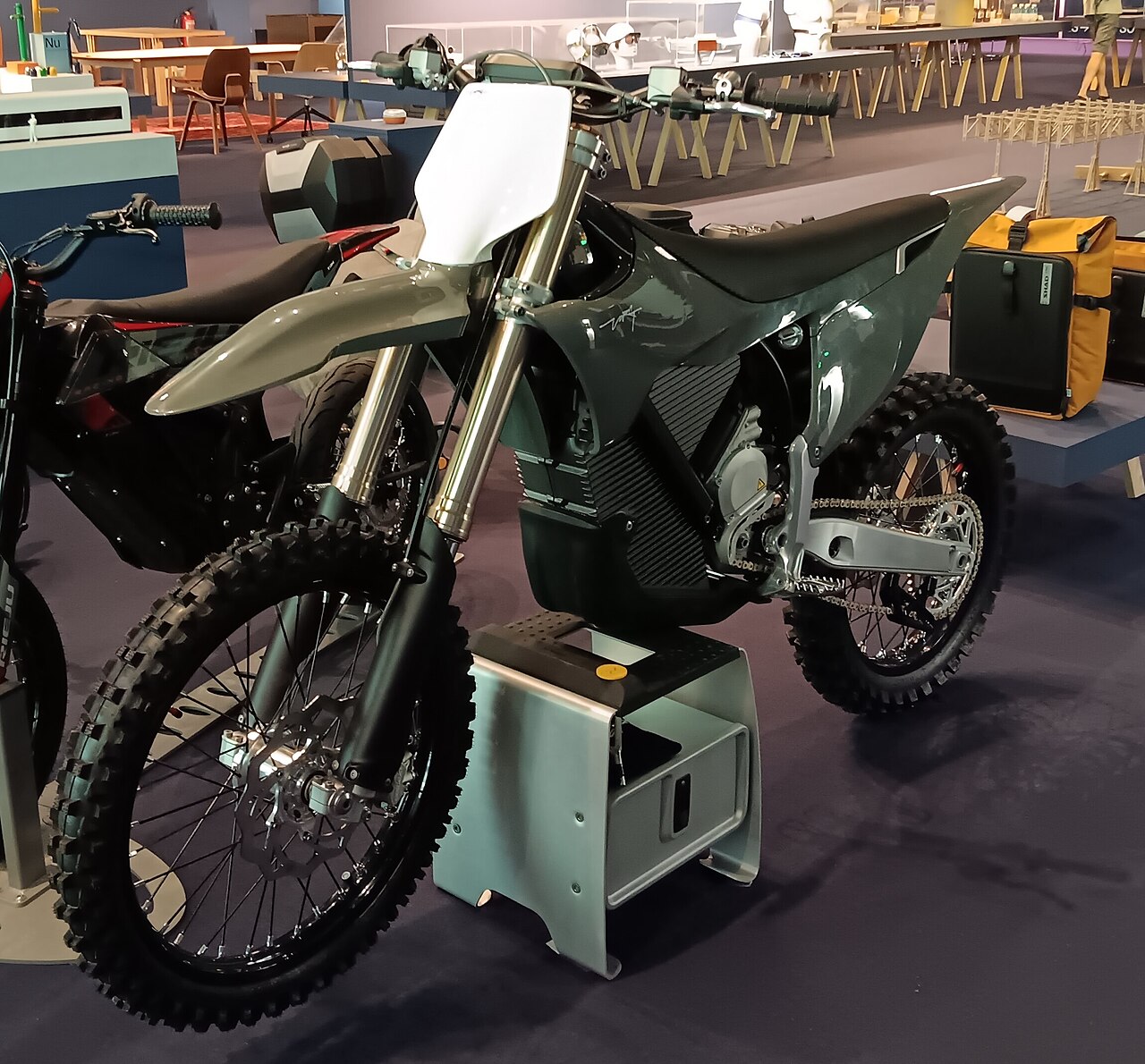
On November 17, Farsoon announced that Stark Future and Farsoon had agreed on multiple FS4X systems to build a series production line. Stark Future S.L. is headquartered in Barcelona, Spain, and makes high-performance electric motorcycles.
The agreement goes beyond hardware. Farsoon says the two companies are jointly developing the complete workflow, covering material and printing parameter development, build preparation, heat treatment, finishing, quality inspection, traceability and production validation. The stated aim is to replace conventional manufacturing for selected metal components.
The deal builds on a partnership the two launched in 2024, when Stark Future adopted Farsoon's large-format FS721M-H-8-CAMS platform. Farsoon cites the joint KLINGA project, which validated repeatable titanium serial production across more than 1,000 parts, as a milestone along the way.
Neither company disclosed the number of machines, the specific parts the FS4X line will produce, or the timeline. VoxelMatters characterizes the purchase as being for Stark Future's upcoming production line. Readers should resist filling those gaps with assumptions; what has been announced is the commitment, not a part list.
Farsoon Europe is at Formnext in Hall 11.0, Booth E11, running November 17 to 20 in Frankfurt, where visitors can watch a video of the FS4X production line. The machine itself will be installed and presented at Farsoon Europe's Innovation Center in Sindelfingen, Germany. Farsoon was founded in 2009 and builds both plastic laser sintering and metal LPBF systems; its European subsidiary, Farsoon Europe GmbH, is based in Sindelfingen.
What It Means for Makers
Nobody is putting an FS4X in a garage. But the machine is a useful indicator of where metal additive manufacturing is heading, and that direction affects what shows up in consumer products, including the vehicles makers ride and modify.
The notable thing here is not peak laser power. It is the attention paid to the unglamorous parts of the workflow: blade changes without exposing the chamber to air, automated calibration, encoder-verified Z motion, AGV-based cylinder transfer and enclosed powder handling. Those are the features that turn a capable printer into equipment a manufacturer can schedule production around, and a motorcycle maker buying several units for a series line suggests at least one customer believes that threshold has been reached.
For makers who design for metal AM through service bureaus, the open-parameter approach is also worth watching. Platforms that let operators tune their own process windows tend to broaden the range of materials and finishes bureaus can offer. The open questions, which Farsoon and Stark Future have not yet answered publicly, are what parts the line will build and how quickly it scales.
Sources
- Farsoon introduces FS4X built around the demands of series production (Farsoon Technologies, Nov 12 2026)
- Stark Future and Farsoon Agree on Multiple FS4X Systems to Build a Series Production Line (Farsoon Technologies, Nov 17 2026)
- Farsoon launches FS4X and partners with Stark Future on metal AM production line (VoxelMatters, Nov 19 2026)
