
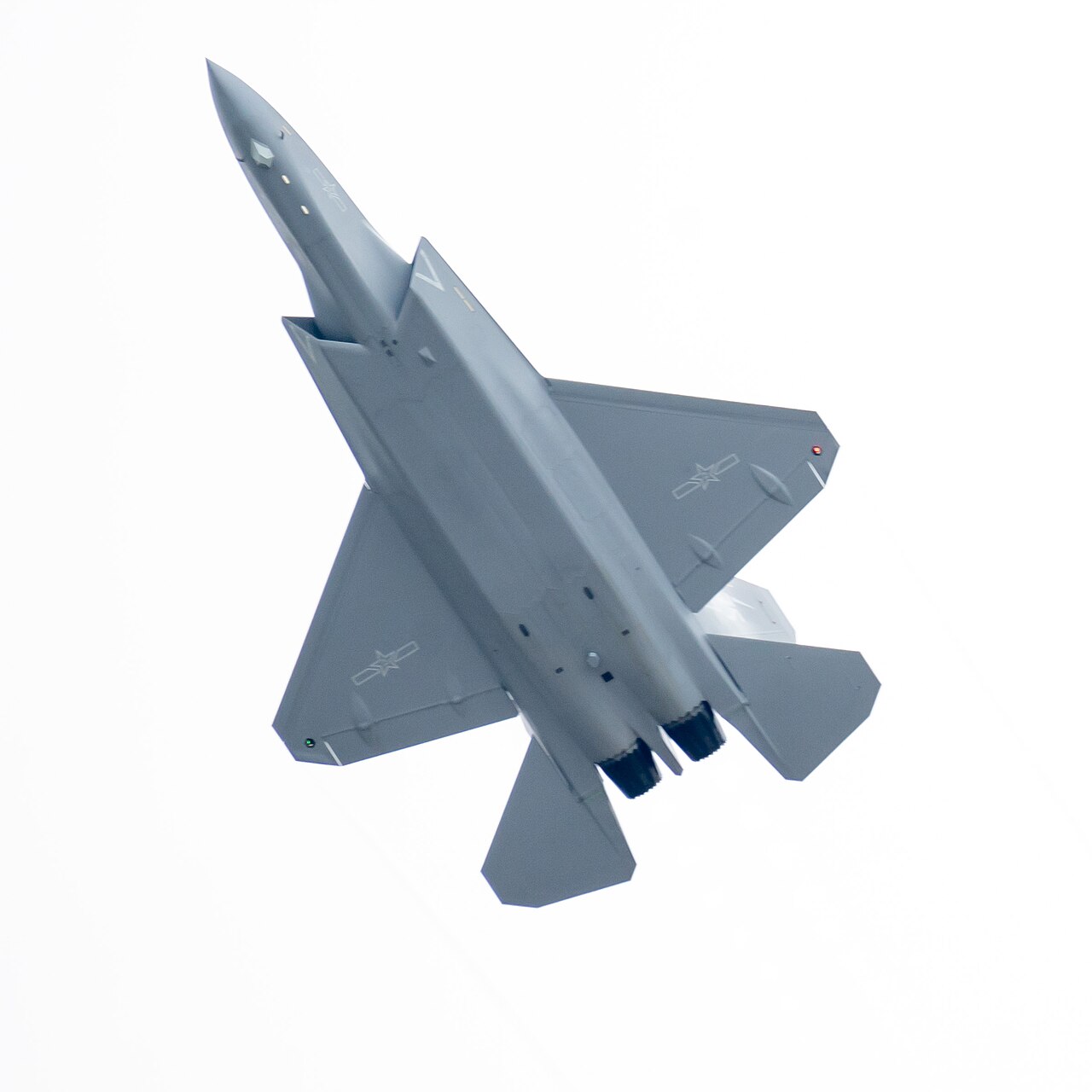
The design institute behind China's J-35 fighter says it has metal 3D printed a primary load-bearing structure more than five meters (16.4 feet) long for an aircraft's central fuselage. That is a very large printed part for a flight structure. The announcement came in a WeChat post from the Aviation Industry Corporation of China (AVIC), which Global Times reported on November 14. Tom's Hardware followed on November 17 with background on how the institute got here. Everything below comes from state media and the company itself, and nobody outside AVIC has verified it. Even so, the engineering approach described is worth a close look. It shows how large-format metal additive manufacturing (AM) is getting around the limits of a single build.
The work comes from the Key Laboratory of Aviation Science and Technology for Novel Aircraft Structures, part of the AVIC Shenyang Aircraft Design and Research Institute. The institute has undertaken the development of more than 40 major aviation equipment models, including the J-8, J-11, J-15 and J-35. According to Global Times, the new part is an integrated structural component in the central fuselage that bears and transfers structural loads. Aircraft designers call that a primary structure: if it fails, the aircraft is in serious trouble. Printed primary structure at this size is rare.
Why Not Print It in One Piece?
The obvious question is why the institute didn't just print the whole thing in one build. Its answer is the same one every maker learns, only with far more energy involved. Large metal prints build up thermal stress. That stress shows up as deformation and, at worst, cracks. Global Times says the team developed its process to address thermal stress, deformation and cracking in large components, and Tom's Hardware reports the structure was not printed as a single piece for exactly that reason: warping and cracking.
Instead, the lab says it combined segmented component printing with what it calls additive fusion joining. As Tom's Hardware describes it, the segments are joined by metal 3D printing into intentionally designed gaps between the components, creating one whole printed piece. The joint isn't a bolted flange or a conventional weld seam added afterward. It is printed into a space the designers left for it. In principle, that lets the joint become part of the same printed structure instead of a separate mechanical interface.
This is a real design choice, not a workaround bolted on at the end. Splitting the part limits how much stress any single build has to manage, and it puts the joints where the engineers want them. The trade is that the joints now carry the load. They need to be validated as carefully as the parent material, and AVIC's post, as reported, gives no figures on joint strength, inspection methods or certification.
Why Titanium Makes the Case for AM
Tom's Hardware puts the announcement in the context of the institute's long history with printed titanium. It says the institute has pursued 3D-printed aircraft parts since 2003. It achieved secondary load-bearing structures in 2005 and large primary load-bearing titanium alloy structures in 2012. That 2012 work earned Wang Huaming and his team China's National Technological Invention Award. The outlet also cites a paper in the Chinese Journal of Lasers, "Progress and Challenges of Laser Direct Manufacturing of Large Titanium Structural Components." Neither source states what alloy the new five-meter part is made from.
The appeal of titanium is clear once you look at the alternatives Tom's Hardware lists. Titanium alloys are notoriously difficult to machine. Cast components are usually weak. Joining parts with bolts and screws adds labor. Metal 3D printing also removes the need for expensive molds, which lets the team iterate faster and build more complex structures. Segmenting the print is how the lab gets past the size limit of a single build.
Cui Can, the lab's deputy director, framed the benefits in terms familiar to anyone who has dropped a tooling step: no molds, rapid production, the ability to fabricate complex structures and closer integration of design and manufacturing. Global Times says the lab has now applied six additive manufacturing processes, 13 types of metal materials and 19 categories of printed structural components in aircraft development programs.
The Heat Exchanger and the Needle Polisher
The fuselage structure is the headline, but the second item in the announcement may be more interesting to engineers. The lab also printed an annular multifunctional heat exchanger that is installed inside an aircraft's air intake. Global Times says it combines four jobs in one part: heat transfer, air extraction, load-bearing and maintenance functions. Its internal flow channels are complex, designed to increase heat transfer surface area while reducing the component's weight. That is the kind of part where AM pays off, because the geometry would be very hard to produce any other way.
Complex internal channels bring an old AM problem with them: you can't easily finish a surface you can't reach. The lab's answer is a magnetic grinding device it developed itself. Fine steel needles go inside the flow channels, and an external magnetic field moves them so they slide, tumble and polish the internal surfaces without damaging the structure. It's a polishing tool built specifically for the problem that printing the part created.
What It Means for Makers
Nobody reading FilamentFeed is printing fighter fuselages. Still, the ideas behind this announcement apply all the way down to desktop printers.
Segmentation is a design discipline, not a compromise. Anyone who has split a cosplay helmet or a long enclosure to fit a 256 mm bed already knows the basics. The AVIC approach goes further. It plans the joint from the start, leaves a deliberate gap and fills it additively, so the seam becomes part of the structure instead of a weak spot. For polymer printing, that suggests planning splits and bonding interfaces as part of the model, not as an afterthought in the slicer.
Thermal stress scales badly. The warping and cracking that pushed AVIC to segment its part is the same family of problem behind a lifting ABS corner. More mass and longer distances mean more accumulated stress. Breaking a large part into thermally manageable pieces helps at any scale.
Post-processing is part of the process. The needle-grinding device is a reminder that a printed part often needs a finishing method designed alongside it, especially once internal channels are involved. If you design internal features, think about how you will clean or smooth them before you commit to the geometry.
The bigger industry signal is that large-format metal AM keeps moving toward primary structures that carry flight loads. It is doing so partly by accepting that the largest parts may not come out of a single build. Without independent data on joint performance, the claims stay claims. But the direction is clear, and segment-and-fuse looks like a pattern worth watching for large parts.
