
Copper has always been a difficult material for laser powder bed fusion, and making the powder costs a lot of energy. A young German company says it can fix both problems at once. FlexCycle Solutions, a spin-off from TU Bergakademie Freiberg, won the Sustainability Award at the 2026 Formnext Awards for a patent-pending process that turns thin-walled copper waste from electronics manufacturing into additive manufacturing powder. The process is purely mechanical. There is no melting, no chemicals and no water. The company says the result uses over 97% less energy than free-fall hot gas atomisation and absorbs roughly twice as much infrared laser light.
The Sustainability Award is supported by Renishaw. FlexCycle took it alongside the other 2026 winners named by organiser Mesago: cAIclone in the Rookie category, sallea AG for Start-up, Thought3D for (R)Evolution and Maya Kaplan for Design. According to VoxelMatters, the Sustainability win carries a EUR 4,000 prize. FlexCycle was also a finalist in the Rookie category, which is notable because the company is still being formally founded.
How the Process Differs From Atomisation
Most metal AM powder today comes from gas atomisation. Metal is melted and the molten stream is broken up by high-pressure gas, which produces the smooth, nearly spherical particles that powder bed machines like. For copper, that means heating the metal to its melting point of about 1085 C, usually under inert gas. The FlexCycle Solutions website puts the cost of this route at 9,000 kWh per tonne of powder or more.
FlexCycle never melts the metal. Its feedstock is foil-like, thin-walled copper residue, the kind of offcuts electronics production leaves behind. The company says it turns this into powder mechanically, at process temperatures below 100 C and without inert gas, for about 650 kWh per tonne. The headline figure needs care. Against the 9,000 kWh floor for gas atomisation, 650 kWh is roughly 93% less. The company's own chart shows free-fall hot gas atomisation at about 25,000 kWh per tonne, and against that figure the saving passes 97%. Mesago's listing makes the 97% comparison with free-fall hot gas atomisation, and about 70% against water atomisation. FlexCycle also claims copper purity above 99.9%, and it sorts the output into six size grades. Mesago's award listing names two recycled fractions, 20-63 µm and 63-100 µm.
The particle shape is the interesting part. Mesago describes the particles as "spherical-rough": the powder still flows well, but with a textured surface instead of the glassy finish of an atomised sphere. Normally that texture would be a flaw. Here the company argues it is the main benefit.
Why a Rough Surface Helps With Copper
Pure copper is famously hard to process with the 1070 nm fibre lasers used in most L-PBF machines, because it reflects much of that infrared light. The usual answers are more laser power, green or blue lasers, or copper alloys that give up some conductivity. FlexCycle's approach is to change the powder instead of the machine. VoxelMatters reports that the rough particle surface absorbs about twice as much 1070 nm light as gas-atomised powder, which matches the "about 2x" figure on the company's website. If more of the beam's energy goes into the powder bed, it should be easier to reach full melting at a given laser power. That is the theory, though no independent print-quality data has been published yet.
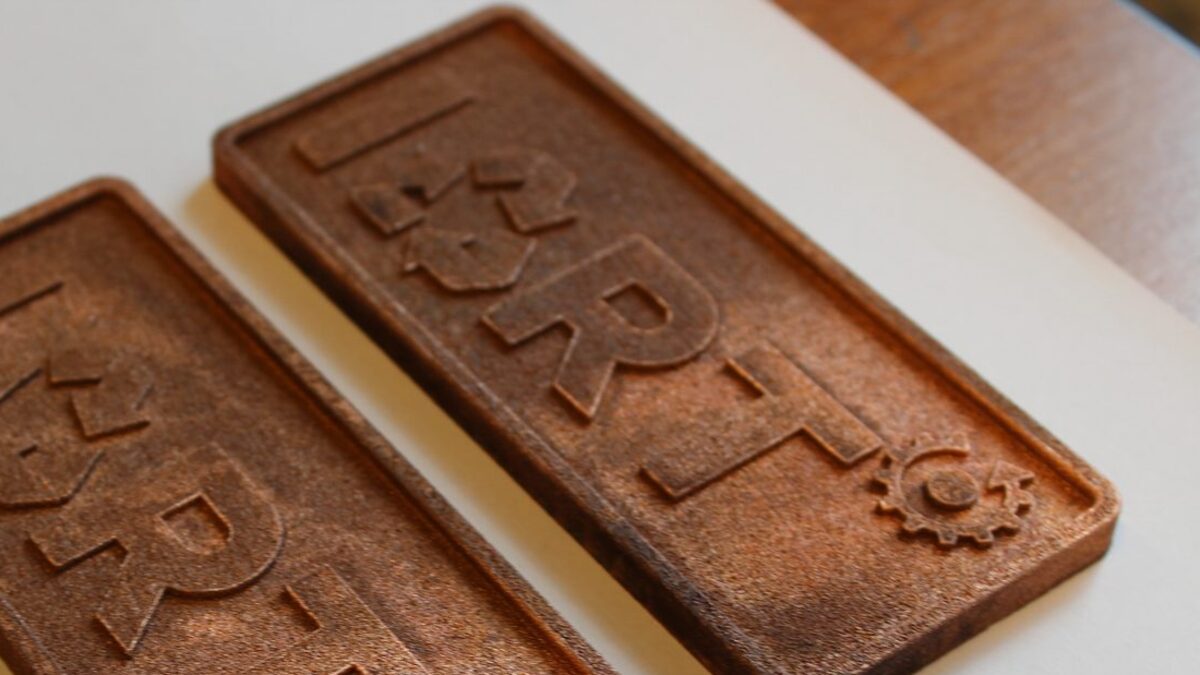
The surface texture also matters outside of lasers. According to Mesago, the rough surface supports green part strength in sinter-based powder metallurgy, and the company's website says the particles interlock for high green strength. The samples FlexCycle showed included a printed IART logo plate and parts from sintering trials. The company calls its L-PBF product the FCP-AM grade and markets it for laser powder bed fusion and directed energy deposition. VoxelMatters notes the powder can also be used in cold spray and binder-based processes.
From Doctoral Research to Pilot Line
The technology comes from the Institute of Mineral Processing Machines and Recycling Systems Technology (IART) at TU Bergakademie Freiberg and builds on doctoral research into metal recycling for additive manufacturing. A university announcement from July 2025 describes validation funding for the project from Sächsische Aufbaubank and the Free State of Saxony, co-financed by the EU's European Regional Development Fund. That announcement lists applications including electromobility, power conversion and high-performance computing, with target markets including electronic components and cooling structures. These all rely on copper for its electrical or thermal conductivity, and the cooling structures in particular are a natural fit for AM's complex internal channels.
One detail is worth noting. The 2025 university announcement cited an energy reduction of "up to 60%." The company's current figure is more than 97%. The available sources do not explain the difference. It could reflect process improvements, a different baseline or a different way of accounting for energy, but none of that has been confirmed. Anyone evaluating the material should ask how the 650 kWh per tonne figure was measured and what it includes.
VoxelMatters reports that the prize money, along with the contacts made at Formnext, will help the company build its pilot line, a phase conducted under EXIST, Germany's research transfer programme. EUR 4,000 will not build a production plant, so the more important result of the award is probably the attention it brings.
What It Means for Makers
Most makers will not be loading FlexCycle powder into a machine any time soon. Copper L-PBF is still mostly an industrial and research process, and this product is at the pilot stage. Still, there are three reasons to follow it.
First, it questions an assumption in metal AM: that the best powder is the smoothest, most perfectly spherical powder. If a rough surface really doubles infrared absorption without hurting flow, it could make pure copper more practical on ordinary fibre-laser machines rather than only on specialised green-laser systems.
Second, the sintering angle is the most relevant one for hobbyists. Bound-metal and sinter-based workflows are the most accessible way to get metal parts outside a factory, and better green strength means parts are less likely to break between printing and the furnace.
Third, the feedstock is waste. Electronics manufacturing produces large amounts of thin copper scrap. Turning it straight into high-purity powder, without melting it down first, is a more appealing recycling story than most "sustainable" material launches. Whether the numbers hold up at scale is the open question, and independent testing of the 2x absorption claim and the energy figures will be the real proof.
