
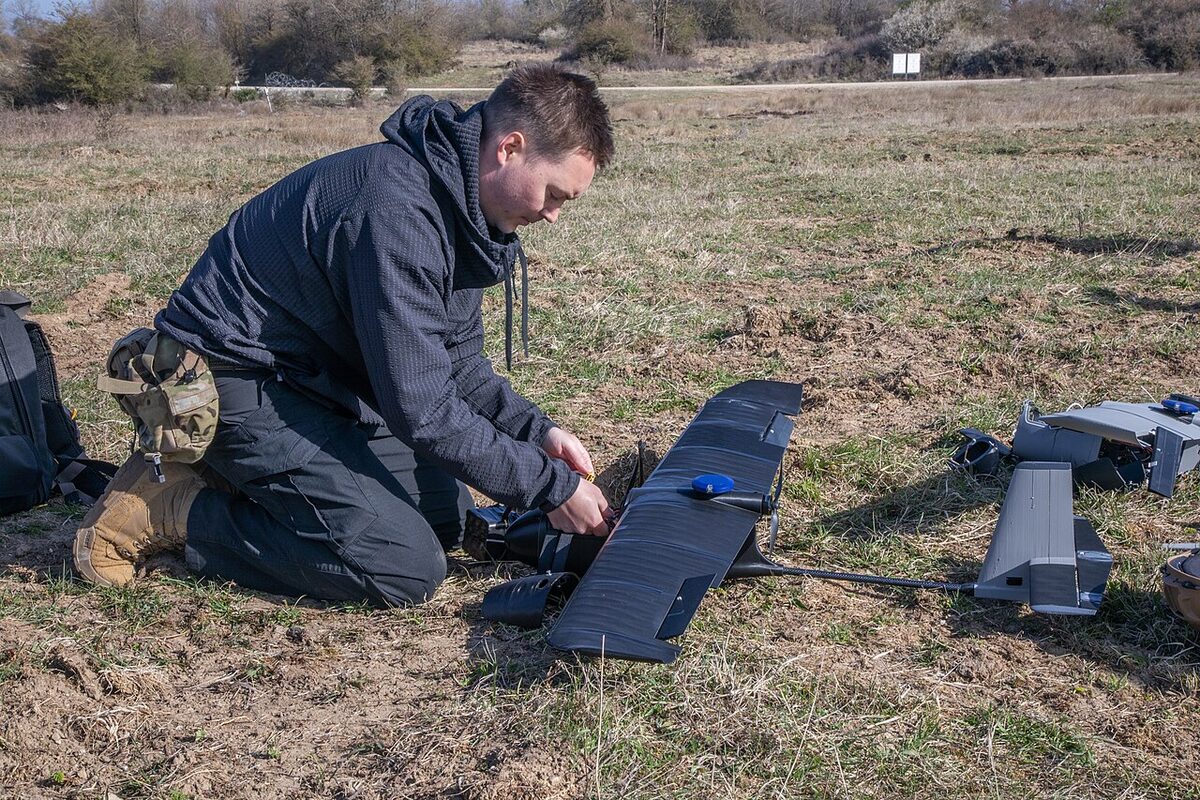
A student robotics team in Germany has put a hard number on a choice many makers make by gut feel. The Frankfurt Robotics Science Team (FRoST) at Frankfurt University of Applied Sciences replaced ASA with carbon-fiber-filled Nylon 11 on structural parts of its DAEDALUS drone. According to Xenia Materials' announcement of the collaboration, the switch to the company's XECARB PA11-CF-SL cut the weight of those parts by about 31 percent, a figure the team calculated in its slicing software. VoxelMatters reports it as more than 30 percent. The team reports that stiffness felt about the same.
The drone was built for the European Rover Challenge (ERC), where it works alongside the team's EROS rover. Xenia backed the project through its Academic and Research Support Program. That makes this a vendor-supported case study, not an independent materials test, and it should be read with that in mind. Still, the print parameters the team shared are concrete enough to be useful to anyone weighing lightweight engineering filaments against the ASA and ABS-family plastics that fill most hobbyist drone frames.
The Parts and the Materials
DAEDALUS weighs 1.7 kg in total, VoxelMatters reports. The team used two Xenia filaments, each for a different job.
The structural material is XECARB PA11-CF-SL. It is a Nylon 11 base, which Xenia describes as 100 percent bio-based, filled with 15 percent carbon fiber. It uses Xenia's SuperLight technology, and the headline spec is density: 0.99 g/cm³. FRoST used it for the drone's motor arms and for the spacers that protect the motor mounts from heat. Those are two of the more demanding locations on any multirotor. Arms carry thrust and vibration loads out to the motors, and the spacers exist precisely because the motors run hot.
For the cover, the team chose XEGREEN PETG-CF, made from 100 percent recycled PETG with 20 percent carbon fiber. Xenia says the carbon-fiber reinforcement made layer lines less visible and gave a more uniform surface finish. On a shell part, finish matters more than structural efficiency.
Where the 30 Percent Came From
The interesting detail is not the material swap alone but the change in slicer settings that came with it. According to both sources, some of the ASA parts needed four perimeters and 40 percent infill to meet the team's target. The PA11-CF-SL versions reached that target with two perimeters and 20 percent infill.
That is half the walls and half the infill. Two effects plausibly stack here. The first is the base material: at 0.99 g/cm³, PA11-CF-SL is light for a filled engineering filament, so every cubic centimeter extruded costs less mass. The second, and probably the bigger lever, is that the part simply contains less plastic. Fewer perimeters and sparser infill shrink the volume of material in each part, and the savings multiply with the density advantage. VoxelMatters notes that part of the saving came from the revised print settings.
Neither source breaks the 30-plus percent figure down into those two contributions. Nor do they say which individual parts were measured or what the "target" was in engineering terms: a deflection limit, a load case, or simply a feel test on the bench. That matters, because the stiffness claim is framed as perceived comparability. This is a practitioner's judgment from people who handled the parts, not a reported modulus or deflection measurement. For a competition team, that is a perfectly reasonable bar. For a maker trying to generalize the result, it is a reminder that "comparable stiffness" here means "good enough for this airframe," not a datasheet equivalence.
Why Carbon-Filled Nylon Can Get Away With Less
The logic behind the result is familiar to anyone who has printed fiber-filled filaments. Chopped carbon fiber generally stiffens the matrix it is mixed into. A stiffer material can carry a given load with less of it. When a designer knows the material is doing more of the work, it becomes possible to thin the walls and open up the infill without crossing the deflection threshold the part has to meet.
ASA, by contrast, is an unfilled thermoplastic and a common default for outdoor parts. To make it rigid enough for a structural part, the usual answer is more material: more perimeters, denser infill, thicker sections. The ASA parts in this project used four perimeters and 40 percent infill, which is consistent with that approach and helps explain why the weight came down so sharply once the material could carry more of the load on its own.
Weight is the currency of anything that flies. On a 1.7 kg airframe, grams saved in the arms and mounts can become flight time, payload margin, or simply more headroom in the thrust-to-weight budget. The team said the lighter structure mattered for a drone designed to operate efficiently and autonomously.
What It Means for Makers
The DAEDALUS numbers offer a useful starting heuristic rather than a recipe. If you are printing rigid structural parts in ASA and finding that you need heavy wall counts and dense infill to stop flex, a lightweight carbon-filled nylon may let you hit the same stiffness with a much leaner print profile. In this case, that meant going from four perimeters and 40 percent infill down to two and 20.
A few caveats apply before you rework your own profiles:
- Re-validate, don't copy. The two-perimeter, 20-percent-infill profile was tuned for these specific parts and this team's target. Your geometry, load paths and failure modes will differ. Print a test part and load it the way it will be loaded in service.
- Stiffness was judged, not measured. If your application has a hard deflection or strength requirement, build your own comparison rather than relying on a perceived equivalence.
- Match the material to the job. FRoST did not use one filament everywhere. The structural nylon went into the motor arms and motor-mount spacers. A recycled PETG-CF, which gave a cleaner surface finish, went into the cover. Splitting materials by function is a sound habit for any multi-part build.
- Consider the whole process. The sources do not cover print settings beyond walls and infill, so plan to dial in your own process and check the manufacturer's guidance.
The sustainability angle is also worth noting. PA11-CF-SL is described as 100 percent bio-based in its Nylon 11 component, and the PETG-CF cover material is 100 percent recycled PETG. For makers who care about feedstock origin, it is a reminder that engineering-grade performance and lower-impact sourcing are not always at odds.
Bottom Line
The FRoST result is a single, vendor-supported data point, and its stiffness claim rests on the team's judgment rather than instrumented testing. But the core lesson is portable. A lighter, stiffer filament does not just save weight by itself. It lets you print less of it. Halving perimeters and infill on a 0.99 g/cm³ carbon-fiber nylon took roughly 30 percent off parts that had been printed in ASA, without a noticeable stiffness penalty on a 1.7 kg competition drone. For anyone building airframes, rover parts or any weight-sensitive mechanism, that is worth a test print.
