
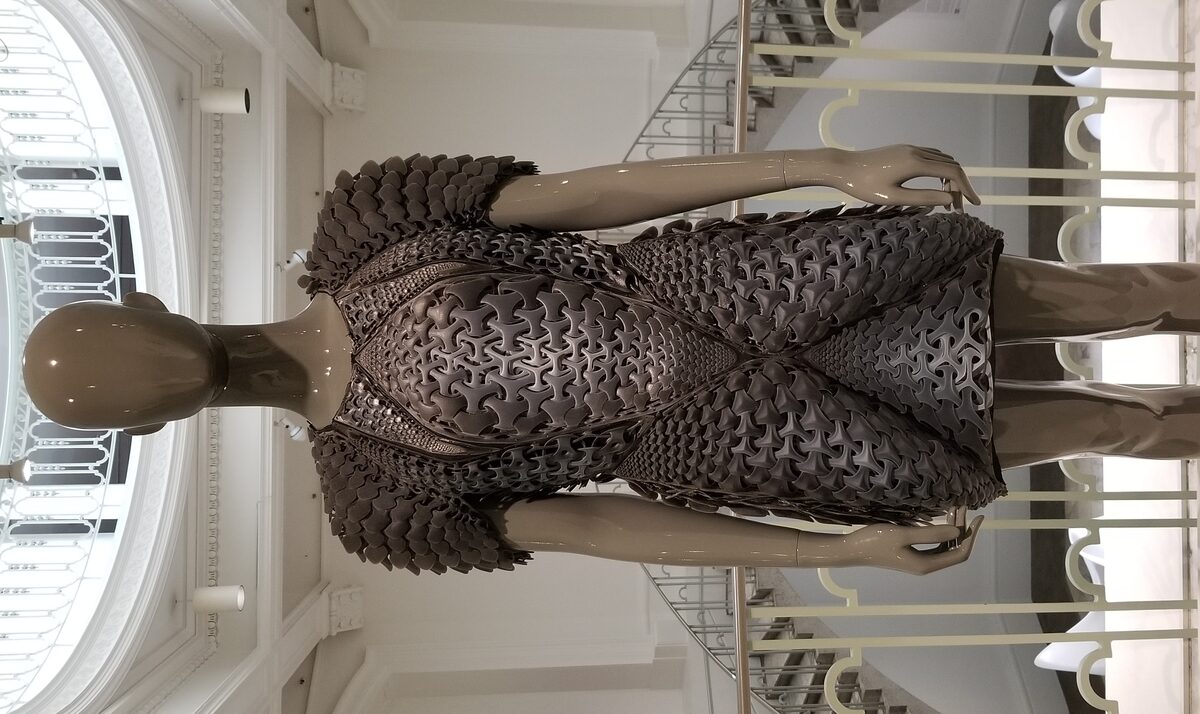
When Duran Lantink took over as creative director of Jean Paul Gaultier, his debut Fall/Winter 2026 haute couture collection leaned on industrial 3D printing to pull off some of its most sculptural pieces. According to a report from 3Dnatives, five looks in the Paris show incorporated components printed by French service bureau Sculpteo using HP's Multi Jet Fusion (MJF) and selective laser sintering (SLS) processes, in materials familiar to anyone who has ordered a nylon or elastomer part from an industrial print shop: PA12 and TPU.
The collaboration paired Sculpteo's production capacity with designer ROMI, credited with developing the printed pieces before they went to Gaultier's ateliers for finishing. That division of labor — a print farm producing raw geometry, a design studio directing form, and hand craftspeople doing the last mile — is the throughline of the whole project, and it's worth unpacking piece by piece, because it's a fairly rare public look at how haute couture houses are actually integrating additive manufacturing rather than just gesturing at it for a press release.
Five Looks, Two Processes, One Very Analog Finish
Per 3Dnatives' rundown, the printed elements broke down as follows:
- Look 7 — a TPU bustier, printed and then coated in latex, with freckles hand-painted onto the surface afterward by Matisse Di Maggio's atelier.
- Look 11 — a PA12-and-TPU guipure-style dress (guipure being a heavy, patterned lace construction), with the bodice and domed skirt structure both printed, then flocking applied by hand — fibre laid directly onto the shell — by Maison du Flock.
- Look 19 — a PA12 "snake-scale" dress, with each scale SLS-printed separately and then hand-sewn onto the garment one at a time.
- Look 26 — a TPU exoskeleton structure, printed in sections and assembled, then covered entirely in pink feathers by plumassier Maison Février.
- Look 32 — a TPU bodysuit forming the structural core, worn under a hand-dyed leather shell built by leatherwork specialists Whitaker Malem, a process that reportedly took roughly eight hours of dyeing work alone.
The material choices track with what each look needed structurally. PA12 — a nylon powder used in both MJF and SLS — is rigid enough to hold fine lattice and scale geometry without collapsing under its own weight, which matters for a guipure-style dress or a scale pattern that needs to read as regular and dense from a few feet away. TPU, by contrast, is an elastomer: it flexes, drapes somewhat, and can be printed as a structural "core" or exoskeleton that a garment builds around, which is exactly the role it plays in Look 32's bodysuit and Look 26's feathered frame. Look 11 draws on both materials at once — a PA12 bodice and skirt structure doing the rigid lattice work.
Both MJF and SLS are powder-bed processes that sinter or fuse material layer by layer without support structures, which is precisely why they're couture-friendly in a way that many desktop FDM or even resin workflows aren't: complex, fully enclosed lattice and lace-like geometry — the guipure dress being the clearest example — comes out of the build chamber ready to be cleaned of loose powder, with no support scars to sand off. That's a meaningful advantage when the printed part is going to be a visible, load-bearing element of a couture bustier rather than a hidden bracket.
What's notable is how little of the final look actually reads as "3D printed" in the finished garment. Every one of the five pieces got a substantial hand-finishing pass — latex coating and hand-painted freckling on the bustier, hand-applied flocking on the lace dress, hand-sewn application of individual scales, feather covering, or hours of leather dyeing. 3Dnatives quotes the framing directly: "The printer made the shape; the ateliers made it couture." The print process supplied geometry that would be impractical or impossible to produce by other means at the required precision — repeating scale patterns, lattice lace, an exoskeleton frame — while the traditional couture workshop supplied everything that actually reads as luxury finish: color, texture, and surface.
The broader show context, independently reported by Daily Front Row back in July, described Lantink's debut collection as sculptural and experimental, citing "anatomical silicone tops" and exaggerated organic protrusions running through the collection. That aesthetic — bodies rendered as structure, silhouettes pushed into biological or exoskeletal shapes — lines up with what 3D printing is good at producing and traditional patternmaking is not: repeatable, precise, organic-looking lattice and shell forms that would be enormously labor-intensive to sculpt or drape by hand at couture tolerances.
What It Means for Makers
None of the specific machines, print settings, or file workflows Sculpteo used were disclosed, so there's no process to reverse-engineer here. But the project is a useful data point for anyone tracking how industrial-grade 3D printing shows up outside of prototyping and end-use mechanical parts.
First, it's another confirmation that PA12 and TPU — both entirely mainstream, widely available powder-bed materials, not some couture-exclusive exotic — are doing the structural work in high-fashion applications, the same materials a maker might order from a service bureau for a drone bracket or a flexible phone case. The couture value-add isn't in exotic materials; it's in geometry (lattice, scale repetition, exoskeletal shells) that would be brutal to produce by hand, combined with finishing work that no printer touches.
Second, the production model is instructive for anyone doing print-then-finish work at any scale: the print supplies a substrate, not a finished surface. Sanding, coating, dyeing, flocking, and hand assembly aren't afterthoughts here — they're roughly half the labor budget on every one of these five looks, right down to an eight-hour hand-dye session on a single piece. That's a ratio worth remembering whenever a 3D-printed prop, costume, or wearable needs to look finished rather than obviously printed: the print gets you dimensionally accurate, repeatable geometry, and everything else is still a craft problem.
Third, this is a rare instance of a major couture house naming its production partner and process rather than treating "3D printed" as a black-box marketing line. Crediting Sculpteo specifically, naming ROMI as the design collaborator, and naming MJF and SLS rather than just "3D printing," is the kind of detail that lets the maker community actually evaluate the claim instead of taking a press release's word for it. The same goes for the finishing side: naming Matisse Di Maggio's atelier, Maison du Flock, Maison Février, and Whitaker Malem as the hands that turned printed geometry into couture is a rare acknowledgment that finishing is its own specialized craft, not an afterthought to the printing.
