
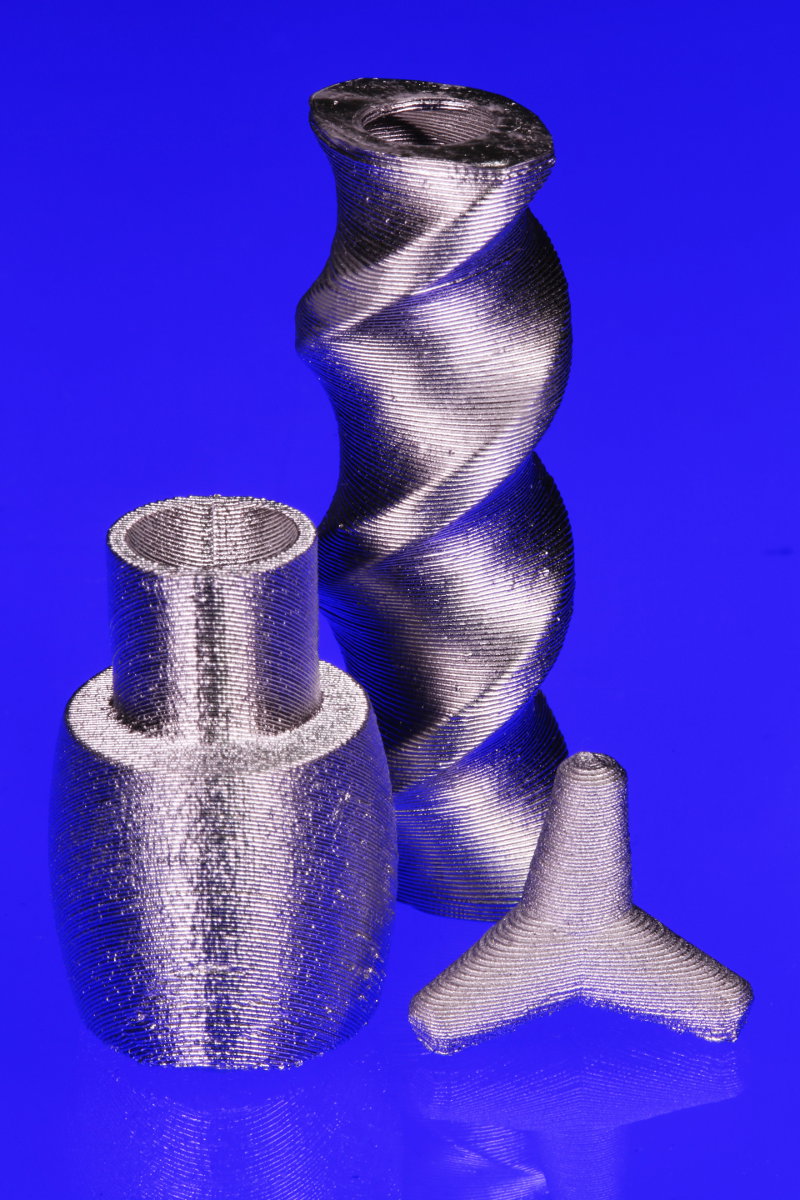
Metal extrusion additive manufacturing (MEAM) has long promised something powder bed fusion and directed energy deposition can't: metal 3D printing without lasers or inert-gas chambers. But aluminum — light, useful, and stubbornly hard to print reliably in this process — has been a persistent holdout. A new peer-reviewed framework and review paper co-authored by Johns Hopkins Assistant Professor Jochen Mueller lays out why, and a companion study details a fix: a simulation-guided thermal control scheme that stabilizes thin-walled aluminum alloy parts by managing heat one layer at a time.
The core problem isn't exotic. It's thermodynamics doing what thermodynamics does when a process built around depositing metal near its melting point meets a metal with unusually high thermal conductivity and a narrow thermal margin for error. MEAM isn't the polymer-bound, powder-based "metal FDM" process some desktop printers use — there's no polymer binder mixed into the feedstock, no porous "green" part, and no separate debinding-and-sintering step afterward. Instead, MEAM extrudes a continuous filament of semi-solid or fully molten metal directly from a heated nozzle, depositing dense metal as it prints. In the Johns Hopkins work, the feedstock was ER4043 aluminum alloy wire — roughly 5% silicon and 95% aluminum by weight — fed into the nozzle and heated to the point of extrudable flow. The mechanics superficially resemble FDM: a heated nozzle, a moving build plate, layer-by-layer deposition. The thermal physics do not, and that mismatch is where aluminum prints go wrong.
Two Ways to Fail, One Root Cause
According to the Johns Hopkins team, as reported by VoxelMatters, high-melting-point metals like aluminum alloys run into two dominant, and seemingly opposite, thermal failure modes in extrusion printing.
The first is underheating. As a part builds, heat bleeds out through the layers already deposited beneath the nozzle. Aluminum's high thermal conductivity accelerates this — it pulls heat away from the deposition zone efficiently, which is great for a heat sink and terrible for a print head trying to keep feedstock flowing. Enough heat loss and the material at the nozzle tip solidifies prematurely, clogging the nozzle mid-print.
The second is overheating, and it's the mirror image of the first. If extrusion outpaces the part's ability to shed heat — a common risk on thin walls, tall vertical features, or anywhere print speed pushes ahead of cooling — heat accumulates layer over layer. Instead of clogging, the previously deposited material remelts or softens under the weight and heat of what's being added on top, and the part loses structural integrity and collapses.
Both failure modes trace back to the same underlying issue: MEAM setups have conventionally treated thermal management as a single global setting — one nozzle temperature, one speed, applied uniformly — when the actual thermal state of a part changes constantly as geometry, wall thickness, and layer height evolve during a print. A setting that prevents clogging on a thick base can cause a thin wall higher up to overheat and slump. A setting tuned to keep a tall thin wall from collapsing can starve the nozzle of enough residual heat to keep extruding cleanly elsewhere.
The Fix: Move the Bed, Not the Nozzle
The Johns Hopkins approach, per VoxelMatters, sidesteps the trade-off by leaving the two variables everyone instinctively wants to tweak — nozzle temperature and print speed — untouched, and instead varying the print bed's temperature layer by layer over the course of the build. The logic is that if you can't safely change how hot the nozzle runs or how fast it moves without triggering one failure mode or the other, you can still control how much heat the part sheds into the build plate underneath it, and that's enough of a lever to keep both failure modes at bay simultaneously.
To make that lever actionable rather than a guessing game, the team applied a time-based minimum-cooling-time criterion for each layer: a calculated dwell before the next layer is deposited, timed to let the current layer reach a solid state first. That criterion is where the "simulation-guided" part of the framework comes in — rather than relying on trial-and-error thermal profiles per part geometry, the bed-temperature schedule and layer timing are derived computationally and then applied during the print.
It's a deceptively simple inversion. Most process engineering effort in extrusion-based printing goes into the hot end and motion system because that's where the deposition physics is obviously happening. This work treats the build plate as a slower, more controllable thermal reservoir that can be scheduled independently — a dial that doesn't fight against extrusion consistency the way nozzle temperature and speed do.
What It Means for Makers
None of this is available as a one-click slicer profile today — the underlying paper is a review and unified framework for MEAM broadly, and the thermal-control study builds on that groundwork rather than shipping a consumer feature. But the direction matters for anyone watching metal printing move toward desktop and small-shop price points.
MEAM's whole pitch is that it's cheaper and less energy-intensive than powder bed fusion or directed energy deposition, and that it can process reactive, low-boiling-point metals — aluminum and magnesium alloys among them — that are difficult or dangerous to handle in laser-based metal AM. Those are exactly the metals hobbyists and small manufacturers most want to print: light, weldable, machinable, useful for brackets, housings, and functional parts, without needing an argon-purged chamber or a laser system that costs more than a car.
Aluminum's clog-or-collapse problem has been one of the practical reasons MEAM machines have leaned on easier, more thermally forgiving alloys rather than aluminum for reliable production. A thermal control scheme that stabilizes thin-walled aluminum parts by scheduling bed temperature and layer dwell time, rather than by derating speed or babying the nozzle, is the kind of unglamorous process fix that tends to show up in firmware and slicer settings on commercial systems a generation or two down the line. If it holds up as machine builders adopt it, expect aluminum feedstocks to become a realistic, not aspirational, option on metal extrusion printers — with the caveat that this framework has so far been validated on one wire alloy and one class of thin-walled geometries, and still has to prove out across the wider range of parts, alloys, and machines that broader adoption would demand.
