
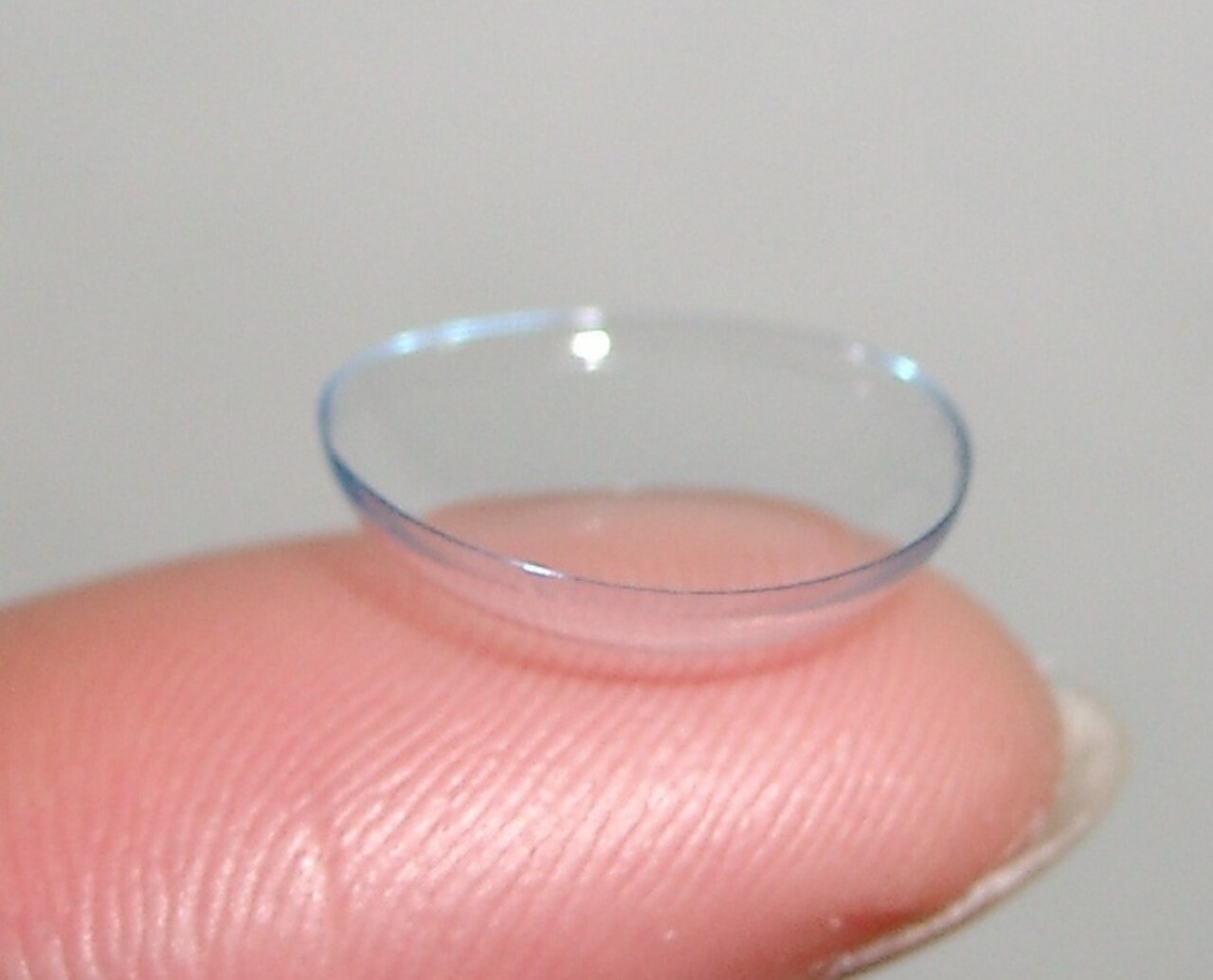
Vat photopolymerization has a well-known problem with optical surfaces: it builds them in layers, and layers leave steps. That is fine for a prototype housing and fatal for something you put on a cornea. Chemists at the University of Waterloo say they have worked around it, announcing on July 14, 2026 a process that prints patient-specific rigid contact lenses in roughly 20 minutes — a purpose-built hydrophilic silicone resin, a resin printer, and an ultra-thin non-contact coating step that smooths the stair-stepping away after the fact. The work is published in Materials & Design under the title "Patient-specific hard contact lenses fabricated by vat photopolymerization printing and non-contact fluidization coating."
Two problems, not one
What makes this interesting to anyone who has run a resin printer is that the team did not try to solve the surface-finish problem the way most people instinctively would — by chasing finer Z steps, better light engines, or more exotic slicing. They split the job in two and attacked each half with a different tool.
The first half is chemistry. Contact lens materials are not a free parameter you get to pick for printability; they have to be biocompatible and they have to let oxygen through to the cornea. That constraint has historically pointed at silicone-based materials, which are not what commercial photopolymer resins are formulated around. The Waterloo group's answer was a novel hydrophilic silicone formulation designed specifically for additive manufacturing, one that still behaves like something a vat photopolymerization machine can cure. That is the sort of trade-off resin formulators live inside — you can usually have any two of printability, mechanical behavior, and the property the application actually needs.
The second half is post-processing. Even with the right resin, layer-by-layer deposition writes its geometry into the surface, and on a lens that surface is the product. The team's solution is an ultra-thin, non-contact fluidization coating: a layer applied without touching the part, which flows over and eliminates the stair-step optical imperfections left by printing — and, per the team, does so without altering the lens shape. Nothing mechanical rides across the optical zone — and polishing a curved surface a few millimeters across is exactly the operation that destroys the geometry the print just hit.
Why "patient-specific" is the whole point
The 20-minute number is the headline, but it is not the interesting part on its own. Contact lenses are already mass-produced cheaply and quickly by lathing and molding. What those methods do not do well is one-offs — and one-offs are precisely what a chunk of patients need.
The target population here is people with irregularly shaped corneas who need rigid lenses, and for whom a lens ground to a standard curve simply does not sit correctly. Additive manufacturing's economics are the inverse of molding's: the cost of a bespoke geometry is essentially the cost of a different file. Waterloo pairs the printer with custom software that designs both surfaces of the lens independently — the inner surface to precisely match the patient's cornea, the outer surface to deliver the vision correction.
"Our software designs a lens with an inner surface that precisely matches the patient's cornea and an outer surface that provides vision correction," said Dr. Sayan Ganguly, a chemistry research associate on the project.
That is the part that makes 20 minutes matter. A short print time is what turns a bespoke lens from a mail-order fabrication job into something that could plausibly happen while the patient is still in the building: scan the eye, design the lens, print it, coat it, dispense it — one visit. A single-visit fitting in an optometry clinic is exactly what the team is aiming at.
The project comes out of the lab of Dr. Shirley Tang, a professor in Waterloo's Department of Chemistry, working with Ganguly and Master of Science student Fatemeh Parniani. "We are very excited about this work because it brings us closer to contact lenses that are truly personalized," Tang said. The work has a clinical partner in the Centre for Vision and Eye Research, a joint institute of the University of Waterloo and Hong Kong Polytechnic University, and it picked up a Gold Medal at the Shanghai International Exhibition of Inventions in June 2026.
How far along this actually is
Awards and press releases compress timelines, so it is worth being precise about where this sits.
Laboratory biocompatibility testing is complete — that box is checked, and for a material going on an eye it is not a small one. In vivo studies are in preparation, which means nobody has worn one of these yet in a published study. A provisional patent has been filed on the hydrophilic silicone material, with a full patent application in progress; a provisional is a placeholder that reserves a filing date, not a granted patent.
So: a real material, real parts, a real optical-finish result, and a plausible clinical path — but a lab-stage result whose next milestone is putting it on eyes. Every step between here and a dispensed product — in vivo results, regulatory clearance, manufacturing validation — is still ahead.
What It Means for Makers
Nobody is printing lenses in a spare room. The resin does not exist outside the lab, the coating step is a published process rather than a bottle you can buy, and the whole point of the thing is medical-grade output for a specific patient's eye. Treat this as news about the state of the art, not a build you can attempt.
The transferable lesson is the one buried in the method. The surface-finish ceiling on vat photopolymerization got beaten here not by pushing the printer harder but by adding a finishing operation that the printer was never going to perform — and by co-designing the resin around the application's non-negotiable property rather than around printability. That is a general pattern, and one the hobbyist side of resin printing under-uses. We reach for finer layers and slower exposures when the honest answer is often that the part needs a post-process — designed in from the start rather than bolted on when the surface disappoints.
It is also a useful data point on where additive manufacturing genuinely wins. Waterloo is not trying to out-produce a molding line; it is going after the population molding lines serve worst. Bespoke geometry, small batch, short turnaround, high value per unit — that is the quadrant where a printer beats a mold, and it holds whether the part is a contact lens or a fixture on your bench.
Watch for the in vivo results. Until those land, this is a very good materials paper with an award on the shelf.
