
Simulation software for metal additive manufacturing has long had a reputation as something bought by aerospace primes and run by specialists. Two stories published by 3D Printing Industry on November 28 suggest that is slowly changing. In the first, Indian developer Paanduv Applications released AM PravaH v3.0, adding part-scale thermo-mechanical analysis and a multiscale workflow for wire arc additive manufacturing (WAAM). In the second, Fives AddUp and ADAXIS detailed how ADAXIS's AdaOne toolpath software now works with Fives AddUp's BeAM 400 and BeAM 800 laser powder directed energy deposition machines, with a turbine blade repair as the showpiece.
The two releases come from different directions. One is a physics solver that wants to tell you what a part will do before you print it; the other is a toolpath planner that is gaining physics awareness so it can tell a machine how to print. Read together, they show the same trend: process knowledge that used to live in engineers' heads and spreadsheets is being folded into software.
AM PravaH v3.0: From Melt Pool to Whole Part
Paanduv has given v3.0 the release name "Enchanting Eagle," and the headline addition is a new finite-element Part Scale module. The workflow is familiar to anyone who has used conventional FEA: import a STEP file, mesh it, then simulate the build layer by layer. The module predicts temperature distribution, deformation and residual stress, which are the three quantities that decide whether a metal print warps off its plate, cracks, or comes out within tolerance. Paanduv says the predictions can help identify distortion and dimensional deviations before fabrication, reducing trial-and-error builds.
Users get two ways to model heat input. Flash heating applies a brief heat input across an entire layer before cooling. The alternative is a moving heat source based on an ellipsoidal Goldak heat flux, a standard model from welding simulation, which lets users represent either an exact or a simplified scan path.
The WAAM addition is a multiscale workflow that combines bead-level simulation for process parameter optimization and defect prediction with microstructure modeling and finite element analysis of layer-by-layer deposition. Users define geometry, deposition paths, material properties and processing conditions, including wire feed rate, travel speed, current and voltage. That matters because WAAM is essentially robotic welding used to build parts, and its outcomes depend heavily on how those welding parameters interact. The simulations predict temperature distributions, thermal history, heat accumulation, cooling rates, deformation and residual stress, giving users a path from a parameter choice to a distortion prediction.
For laser powder bed fusion, v3.0 adds scan-pattern generation directly in the GUI, with control over layer count, cooling time, scan speed, hatch spacing, layer thickness and other settings. Paanduv also updated its WLAM and WAAM solvers, aiming at better computational efficiency and robustness. The microstructure module applies a Monte Carlo technique to thermal data from melt-pool simulations, and the Utilities section includes Rosenthal-based microstructure prediction, simulation queuing and deep-learning tools.
The software is available for Windows and Linux, and Paanduv offers teaching, research and commercial licenses. CEO and founder Adwaith Gupta is quoted in the 3D Printing Industry report. The article places the release alongside other recent moves to put simulation closer to production, including AMCM integrating PanOptimization's PanX with EOSPRINT and Aibuild adding finite-element thermal simulation to its large-format toolpath platform.
AdaOne Meets BeAM: Toolpaths for DED
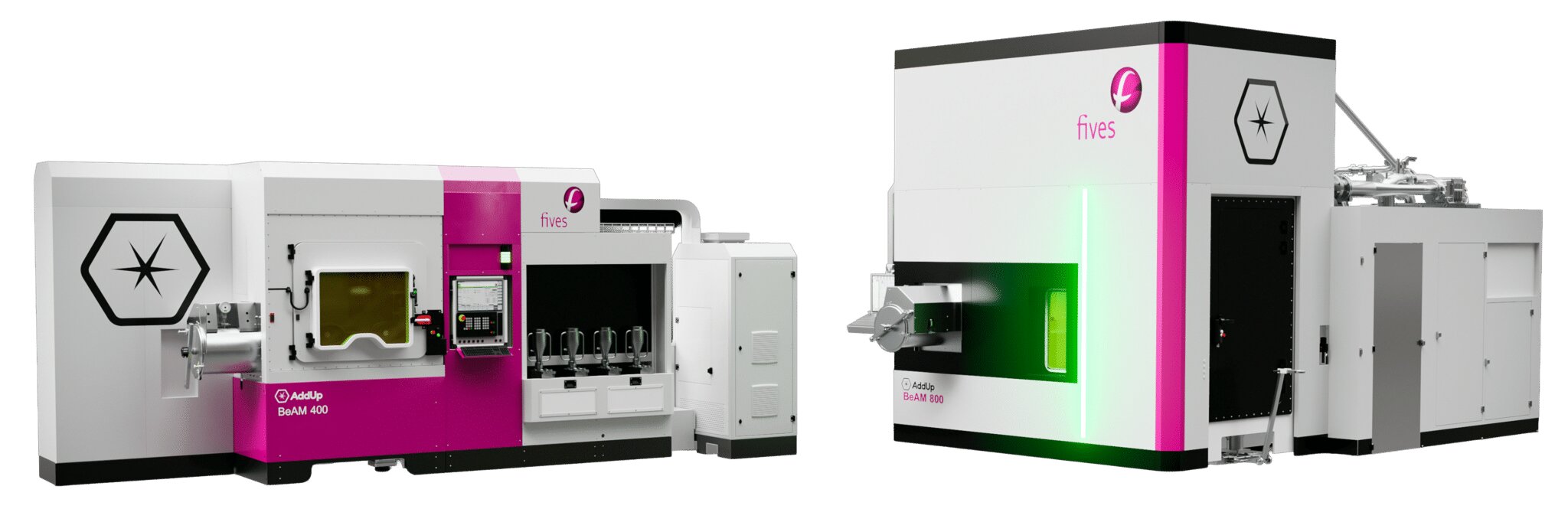
The Fives AddUp and ADAXIS news is not quite as fresh. The partnership was announced at Formnext 2026 in Frankfurt on November 17; the 3D Printing Industry write-up appeared on November 28. The substance is that AdaOne, ADAXIS's software, is now compatible with the BeAM 400 and BeAM 800, laser powder DED machines (designated DED-LB/P). Users can prepare jobs, generate multi-axis toolpaths, simulate machine motion and create programs within AdaOne.
DED is a different animal from powder bed fusion. Instead of fusing a thin layer of powder in a bed, a laser melts powder blown into a moving melt pool, usually from a multi-axis head, which makes it well suited to large parts, added features and repair.
The roadmap the companies laid out targets exactly those problems. They plan to bring DED-specific physics into AdaOne, including variation in laser power and powder flow, speed changes during acceleration and deceleration, and heat build-up. Thermal simulation under real manufacturing conditions and the use of machine parameters and sensor data are also on the list, as is programming of functionally graded materials through BeAMix, which would allow material composition to vary within a single part.
At Formnext, in Hall 11.0 at booth D32, the partners showed two demonstration parts. One was a large Maraging 300 steel valve built on a BeAM 400, demonstrating a deposition rate of about 1 kg/h. The other was a Ti-6Al-4V turbine blade restored on a BeAM 400 with multi-axis toolpaths optimized in AdaOne, the scenario that gave the article its headline: repairing a worn high-value part rather than scrapping and replacing it. ADAXIS CTO Guénolé Bras and Fives AddUp's Thomas Elcrin are both quoted on the collaboration.
AdaOne is not tied to dedicated DED cells. It is compatible with robot brands including KUKA, ABB and Fanuc, and it is on the Software Tool or Company of the Year shortlist for the 2026 3D Printing Industry Awards. The report also points to related moves elsewhere in the industry: Dyndrite's LPBF Pro integrating direct scan-card control for Xact Metal machines, and a partnership between wire-arc DED developer DEEP Manufacturing and Fortius Metals on simulation and toolpath design.
What It Means for Makers
Few readers have a BeAM 800 in the garage, so the direct impact on hobby printing is limited. The indirect impact is more interesting. WAAM in particular sits close to the maker world: it is built on welding equipment and industrial robots, the kind of hardware already found in fabrication shops. Software that takes wire feed rate, travel speed, current and voltage and returns a distortion and residual-stress prediction speaks the language of people who weld, not only of simulation specialists.
The broader lesson applies to anyone who has fought warping on a large print. Thermal history drives distortion, whether the material is PETG or titanium. What is changing in metal AM is that software increasingly models that history before the build, through layer-by-layer FEA in AM PravaH, or through physics-aware toolpaths in AdaOne, instead of leaving it to trial and error.
Some caution is warranted. Both accounts here come from trade-press coverage rather than independent testing, and neither article, as far as we could see, includes validation data comparing predictions with measured parts. The AdaOne physics features are described as roadmap items, not shipping functions. Until users publish results, treat both as promising capabilities rather than proven ones.
Bottom Line
AM PravaH v3.0 broadens a simulation package from process-scale physics to whole-part stress and distortion, with notable attention to WAAM. AdaOne on BeAM machines brings a multi-axis toolpath tool to laser powder DED, with repair as the flagship use case. Neither is a revolution on its own, but both push metal AM toward planning parts in software first.
