
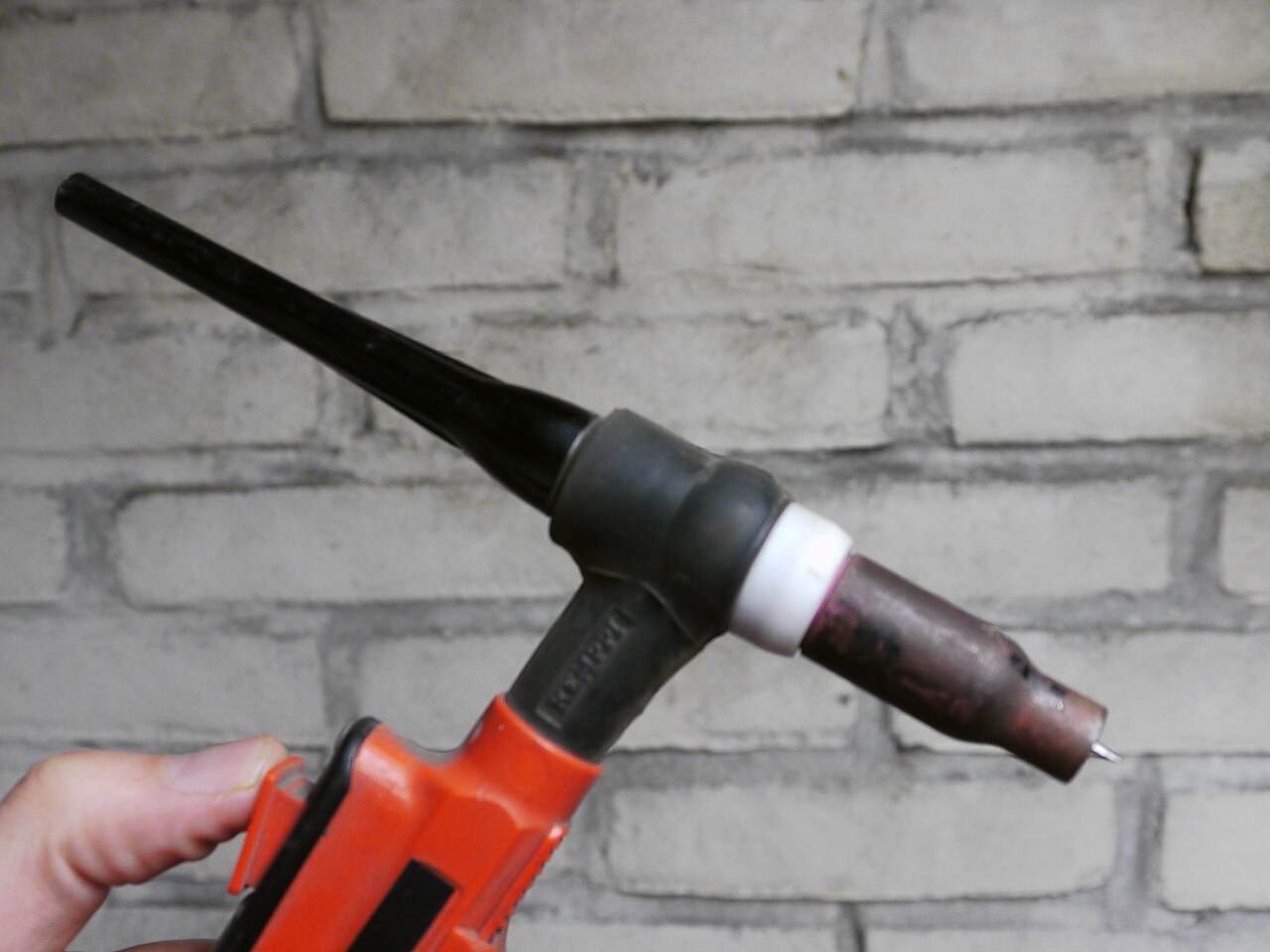
Nippon Sanso has brought its 3DPro RotoTIG torch to Europe, showing the wire-fed metal additive manufacturing tool at Formnext 2026 in Frankfurt. According to the company's announcement, dated 16 November 2026, RotoTIG adapts the company's proprietary Rotary TIG Welding Technology to deposition work: the metal wire is fed through the center of the torch, and a tungsten electrode rotates around it. The point is geometric. Because the electrode orbits the wire instead of sitting off to one side, the electrode-to-wire relationship stays the same no matter which way the torch is moving.
Alongside the torch, the company showed the latest version of its 3DPro DryCabinet, a storage unit for metal powder containers. 3D Printing Industry covered the European debut, noting that the two products address different areas of metal AM: wire-fed deposition on one side, powder storage on the other.
The Problem With Pointing a Torch
Anyone who has thought about wire-fed deposition knows the awkward part is not the arc; it is the direction. When wire enters the melt pool from one side of a heat source, the process behaves differently depending on whether the torch is moving toward the wire, away from it, or across it. That asymmetry pushes tool-path planners toward compromises, such as restricting travel directions, reorienting the head between moves, or accepting variation in the bead from one segment to the next.
RotoTIG's answer is to make the head effectively direction-agnostic. With the wire on the central axis and the tungsten electrode rotating around it, there is no "leading" or "trailing" side for the wire relative to the electrode. Nippon Sanso says this gives greater freedom in tool-path design and supports consistent heat input and material deposition. 3D Printing Industry summarizes the claim as a consistent electrode position regardless of scanning direction.
That is the core pitch, and it is a reasonable one. If a deposition head behaves the same way in every direction, the slicing and path-planning software has fewer constraints to respect, and the part's properties should, in principle, depend less on how a given layer happened to be routed. Neither source provides deposition rates, compatible alloys, wire diameters, power ranges or pricing, so how well the claim holds up in production remains to be shown by users and published data rather than by the press release.
Where RotoTIG Comes From
The torch is not new to Japan. According to 3D Printing Industry, Japan-based Taiyo Nippon Sanso (TNSC) announced the Roto TIG torch and its associated AM process in 2024, and it was working with Japanese manufacturer Sugino Machine toward commercialization. What changed at Formnext 2026 is the market: Nippon Sanso, the European business formerly known as Nippon Gases and part of Nippon Sanso Holdings, is now presenting the technology to European customers.
The torch also fits into a broader effort. 3D Printing Industry reports that in 2020 TNSC opened an additive manufacturing R&D hub at its Yamanashi Laboratory in Japan, which combined Velo3D Sapphire systems, Optomec LENS directed energy deposition equipment and the company's own 3DPro products. RotoTIG extends that portfolio into wire-fed deposition, giving the group a foothold in both powder-based and wire-based metal processes.
The company's own framing is about breadth. In the release, Raoul Giudici, President of Nippon Sanso in Europe, calls the launch an important step in the continued development of the company's additive manufacturing portfolio. For an industrial gas supplier, that is a logical direction: shielding gas is central to TIG processes, and inert atmospheres are central to powder storage, so equipment that touches both is close to the company's existing business.
The Powder Side: DryCabinet
The second product is less exotic but addresses a problem anyone running powder-based metal AM knows well. The 3DPro DryCabinet stores metal powder containers under an inert atmosphere with controlled low oxygen and humidity levels. Nippon Sanso says the goal is to protect powder against oxidation, agglomeration and deterioration in flowability.
Each of those failure modes matters. Oxidized powder can change the chemistry of a finished part. Agglomerated powder, where particles clump together, does not spread evenly. Poor flowability compromises the uniform layers that powder bed fusion depends on. Powder that sits around between builds, or gets opened and resealed repeatedly, is exposed to exactly the conditions that cause these problems. A controlled cabinet is an unglamorous fix, but storage discipline is one of the more practical levers a shop has over consistency.
The pairing of the two products is telling. RotoTIG addresses deposition with wire, which sidesteps many powder handling issues entirely, while DryCabinet targets shops that are committed to powder. Nippon Sanso is effectively selling into both camps at once.
The Company Behind It
According to the release, the Nippon Sanso group draws on more than 100 years of experience, operates in more than 30 countries and employs more than 20,000 people worldwide, including more than 4,000 in Europe across 14 countries. Visitors could see both products at Formnext in Hall 11.0, Stand C49.
What It Means for Makers
Let's be clear about the audience: RotoTIG is industrial equipment, aimed at manufacturers doing wire-fed metal deposition, not at anyone printing PLA on a desktop machine. Neither source mentions a hobbyist product, a price, or a ship date for European customers.
That said, the idea underneath it is worth understanding for anyone interested in where metal printing is heading. Direction-dependent behavior is a recurring theme in additive manufacturing. Desktop FDM users deal with their own versions of it, from cooling that favors one side of a nozzle to seam placement and anisotropic layer strength. RotoTIG is a hardware answer to a hardware asymmetry: rather than teaching the software to work around a lopsided tool, it makes the tool symmetrical. When that approach works, the software side gets simpler and the results get more predictable.
For makers who work in or near small metal fabrication shops, the more immediately relatable lesson may be the DryCabinet's. Metal powder, like hygroscopic filament, degrades when stored carelessly, and the fix in both cases is controlled storage. The scale and the atmosphere differ, but the principle is the same one that has filament users buying dry boxes.
The bottom line: Nippon Sanso is making a credible claim about a real limitation of wire-fed deposition, and it is backing that with a storage product for powder users. Whether RotoTIG becomes a common sight in European shops will depend on numbers the company has not yet published.
