
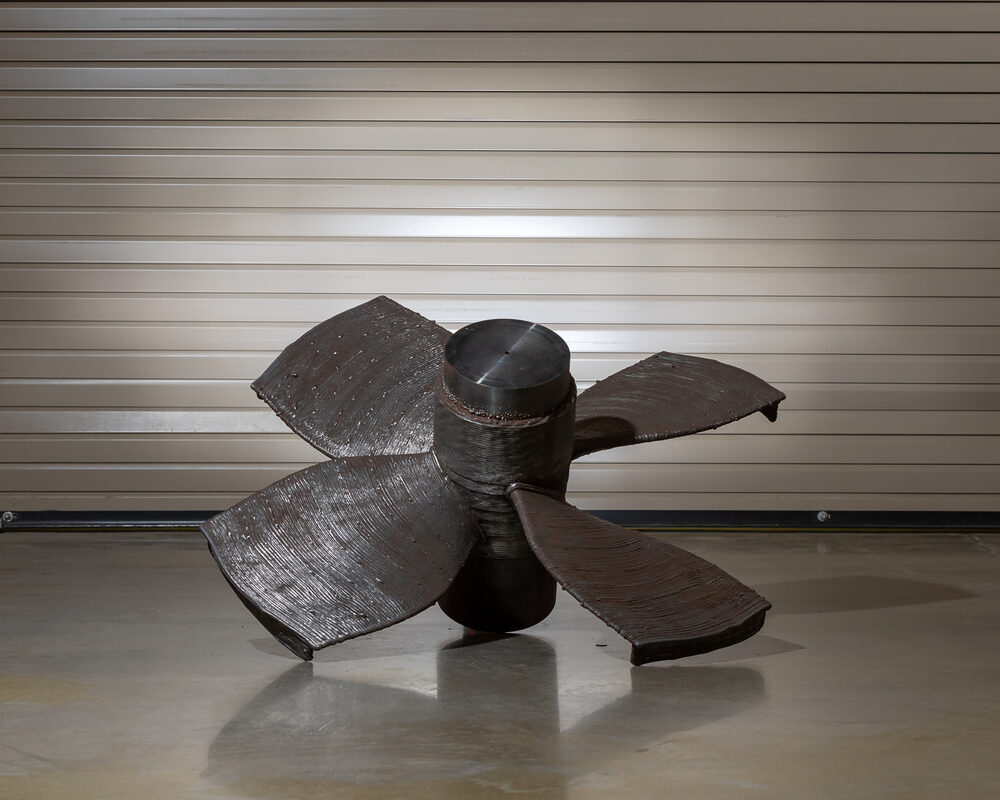
Two of the U.S. Department of Energy's national laboratories say they've printed their way toward a shortcut for one of nuclear power's biggest bottlenecks: getting a metal part certified safe to sit inside a reactor. According to a joint ORNL/INL release published via EurekAlert, Oak Ridge National Laboratory (ORNL) and Idaho National Laboratory (INL) have unveiled a nuclear-grade steel pressure vessel roughly 3 feet by 5 feet, built with wire arc additive manufacturing (WAAM) and shown publicly at the Materials and Manufacturing Innovation Days (M2IND) event.
If you've never encountered WAAM, think of it as the industrial, heavy-metal cousin of the FDM printer on your bench: instead of extruding molten plastic through a nozzle, an electric arc melts metal wire feedstock and deposits it layer by layer, building up thick steel structures at a scale no desktop printer could touch. ORNL's version of this process runs on a platform called MedUSA, which coordinates three robotic arms working together to lay down material — a setup built for exactly the kind of large, thick-walled geometry a pressure vessel requires.
Why a Pressure Vessel, and Why Now
Pressure vessels are about as unglamorous as nuclear components get — thick-walled steel containers designed to hold pressurized fluids or gases safely for decades. But they're also a chokepoint. Qualifying a new pressure vessel design or a new manufacturing process for nuclear service traditionally takes years of testing, documentation, and regulatory review, because the consequences of an undetected flaw are severe and the components are expected to perform reliably for the life of a reactor.
That qualification timeline is increasingly a supply-chain problem. Per the labs' release, wire arc additive manufacturing "may diversify manufacturing options to enable a domestic supply chain" — a concern that maps onto the broader push for new reactor designs, including microreactors, that need forged or fabricated components faster than the traditional casting and forging industry can turn them around. Coverage from VoxelMatters notes this push is happening against a backdrop that includes Antares Nuclear's R1 Mark-0 microreactor reaching criticality in June 2026 — a reminder that the advanced-reactor pipeline is producing hardware faster than qualification processes have historically been able to absorb.
The Real Innovation Is the Data, Not the Metal
The printed vessel itself — built by Manufacturing Demonstration Facility scientists in July using wire arc 3D printing, then shown publicly at M2IND in August — is more of a proof point than the headline. The bigger claim from both labs is about what happens during the print, not just what comes out of it.
Patxi Fernandez-Zelaia, ORNL's lead researcher on the project, put the goal in blunt terms in the release: the labs "would like to achieve born-qualified pressure vessel components using data gathered during printing to confidently assess their worthiness for extreme environments." That phrase — born-qualified — is the crux of the pitch. Rather than printing a part and then subjecting it to a separate battery of destructive and non-destructive testing, the labs want the qualification evidence generated as a byproduct of the print itself: in-situ sensor data captured layer by layer, then used to show the finished part meets spec without a traditional post-hoc test cycle.
INL group lead Jorgen Rufner frames the same idea from the data-science side: the project brings together AI and data science with advanced 3D printing "so we can evaluate a part's performance in real time, while it's being printed, instead of waiting for post-production testing" — in other words, using machine learning models trained on process data to flag deviations as they happen rather than discovering a flaw only after the part is finished and sectioned for inspection.
The two labs are explicitly splitting the work along their traditional strengths. Per the release, the collaboration leverages "expertise in additive manufacturing and real-time accuracy monitoring, parts qualification, and nuclear material properties and their long-term performance" — the kind of multi-decade materials-science knowledge that determines whether a steel alloy will still be trustworthy after years of neutron flux and thermal cycling.
VoxelMatters also notes that ORNL has already used MedUSA to produce neutron sensor brackets for Antares Nuclear's R1 Mark-0 microreactor — a considerably smaller component than a pressure vessel, but one that suggests the labs see the born-qualified approach as a methodology to generalize across nuclear hardware, not a one-off stunt built around a single large part.
What It Means for Makers
None of this is desktop-relevant hardware — MedUSA's three-arm robotic WAAM cell and nuclear-grade alloy qualification pipelines sit about as far from a Bambu Lab or Prusa as 3D printing gets. But the underlying trend is worth watching for anyone who follows metal AM generally. In-process monitoring — using thermal cameras, melt-pool sensors, or acoustic data captured during a print to infer part quality without cutting the part open afterward — has been creeping down from aerospace-grade metal printing into more accessible systems for a few years now, and directed energy deposition and WAAM processes are exactly where that kind of real-time monitoring is most mature, because the deposition rates are slow enough and the layers thick enough to make in-situ measurement practical.
The "born-qualified" framing is also a useful concept for anyone printing functional parts under any kind of quality standard, hobbyist or professional: the more your printer or process can tell you about a part while it's being built, the less you have to rely on destructive testing or over-engineering margins after the fact. If national labs can prove that concept out on something as high-stakes as a nuclear pressure vessel, the sensor and software techniques involved — anomaly detection on deposition data, real-time process control tied to a quality model — are the kind of thing that eventually filters down into commercial metal-AM machines, and from there into the broader tooling ecosystem that makers eventually get access to secondhand or via open designs.
For now, this is a research milestone, not a shipping product: no timeline was given for when a born-qualified pressure vessel might actually enter a reactor supply chain, and the vessel shown at M2IND is a demonstration piece rather than a certified component. But it's a clear signal that the DOE labs see additive manufacturing's qualification bottleneck — not the printing itself — as the thing actually standing between metal 3D printing and a real role in nuclear infrastructure.
Sources
- National laboratory research collaboration focuses on accelerated qualification of critical nuclear components — joint ORNL/INL release via EurekAlert, Aug 21, 2026
- Oak Ridge and Idaho national labs demo wire arc 3D printed pressure vessels — VoxelMatters, Aug 23, 2026
