
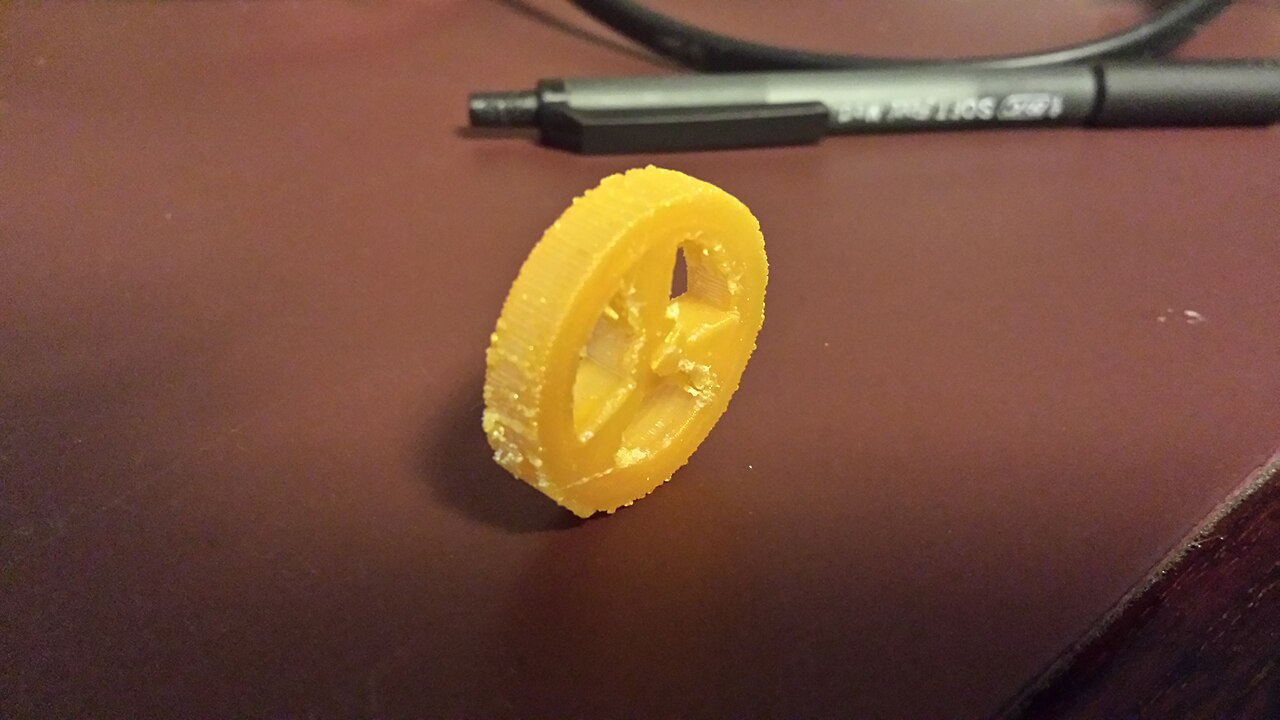
Ukrainian additive manufacturer Print&Live UA and Swiss large-format printing specialist iSCALE 3D have taken their 3D-printed airless wheels for unmanned ground vehicles through field and combat trials, and they are now building additional printing equipment for UGV makers moving into series production, 3D Printing Industry reported on October 8, 2026. The cost is the headline. A full set of printed wheels comes to about EUR 680, while comparable imported wheels cost US$3,000 to US$4,000 or more. For the small robotic carriers that now move supplies and casualties near the front line, that difference shapes how many vehicles a unit can keep running.
This is not a lab demonstration that has been dressed up for a press release. The wheels ran on vehicles operated by two Ukrainian military units, including in winter combat, and the reported results include distance, payload and temperature, which makes them easier to judge than most claims about functional printed parts.
The Trials
The longest documented run used a TARGAN 3K 244 EVO 1 UGV operated by the 3rd Separate Assault Brigade. According to 3D Printing Industry, the vehicle first covered 210 km on a test range. It then logged 151 km over 11 combat missions in winter, at temperatures from 0 to -15 °C. Across those missions it moved 1,825 kg of cargo and evacuated a wounded person.
The second platform was a Rys Pro UGV operated by the 49th Separate Assault Battalion "Karpatska Sich," over boggy and frozen ground. That vehicle weighs roughly 600 kg empty and up to 800 kg fully loaded, and during testing it also towed another UGV. The report says every wheel kept its load-bearing capacity, with no delamination and no structural cracking. For a layer-built part under repeated load, those are the two failures most worth checking for.
iSCALE3D's own site gives a cumulative figure. It describes the wheels as tested through 646 km of mud, snow and frozen terrain on real evacuation and logistics missions. The manufacturer does not break that total down by vehicle on its homepage, and it is larger than the TARGAN figures alone. Readers should treat it as the company's overall program number, not a figure derived from the two trials described above.
How the Wheel Is Built
The design follows the usual airless-tire logic: replace the pressurized air chamber with a structure that carries the load and flexes to absorb shocks. In this case that structure is an adaptive lattice printed from high-load elastomers and polymer composites. "Adaptive" here means a lattice whose geometry is tuned to carry load where it is needed, rather than a uniform infill pattern.
Several other details stand out in the 3D Printing Industry description:
- Rounded tread. The report says the rounded profile shrinks the contact patch and lowers rolling resistance on rough ground.
- Closed sidewalls. Open-spoke airless designs can pack with mud, snow and debris. In the conditions these vehicles face, packed cells add weight and change how the wheel behaves mid-mission. Print&Live closed the sidewalls entirely to keep material out.
- A patented two-piece rim. According to the report, it means fitting or swapping the tire needs no tyre-changing machine or press; technicians can do it on site with basic hand tools.
The wheel has no air in it, so it cannot be punctured. iSCALE3D lists that as a primary feature. For a vehicle that may be driven over shrapnel-strewn ground, it is the main operational reason to go airless at all.
The Weight Argument
Price gets attention, but weight may matter more to the people operating these robots. 3D Printing Industry reports that a printed set weighs 32 to 56 kg, compared with 88 to 144 kg for Western airless wheel sets. iSCALE3D's site gives a figure of 16 to 22 kg for a complete wheel. The sources do not say how many wheels make up a "set" in each comparison, so we have not tried to reconcile the two numbers.
Less rotating and unsprung mass on a battery-powered vehicle means more energy goes into moving the payload. The developer estimates the printed wheels can extend range by up to 30% compared with imported airless alternatives, largely by reducing battery drain. That is a manufacturer estimate, and the report does not describe the test method behind it, but the direction is plausible given the weight difference cited.
Why Printing Fits This Problem
Large-format additive manufacturing has spent years looking for applications where its trade-offs make sense: modest part counts, large parts, geometry that molding cannot easily produce, and a need for fast design changes. UGV wheels in an active conflict meet almost all of those conditions.
Vehicle types vary, and new platforms keep appearing. Tooling up an injection-molded or cast airless tire for each wheel size and load rating takes time and money that a rapidly shifting fleet does not have. A printed lattice can be resized or retuned for a heavier platform by changing a file, not a mold. Imported wheels also come with long supply lines and the price premium that 3D Printing Industry's figures show. Producing wheels domestically from printers removes both problems.
The constraint is likely throughput, which is why the "adding printing capacity" part of the announcement matters. Moving from trial quantities to series production is mostly about how many large-format machines are running and how consistently they produce good parts. The report presents the scale-up as the next step after the combat trials, not as finished.
What It Means for Makers
Most FilamentFeed readers are not building military robots. Still, this program is a useful example of how functional elastomer printing is developing, and three points apply well beyond defense.
First, lattices printed in flexible material are now load-bearing parts with documented field use, not just showpieces. A vehicle of up to 800 kg loaded, with no reported delamination, is encouraging evidence that layer adhesion in engineered elastomers can survive real duty cycles, and the TARGAN's winter missions down to -15 °C add cold-weather data.
Second, the design choices are worth copying at hobby scale. Closed sidewalls to keep debris out of a lattice, and a split rim that makes the tire section replaceable, apply just as well to a printed wheel for a garden cart, a combat-robot chassis or a rover.
Third, it shows clearly where printing beats conventional manufacturing. The numbers here come out ahead not because printing is cheap per kilogram, but because it avoids tooling, avoids import logistics and produces lighter structures than the conventional parts it replaces. If you are deciding whether to print a part or buy it, those are the questions to ask.
Bottom Line
Print&Live UA and iSCALE 3D have published test data that is unusually specific: distances, payloads, temperatures and a casualty evacuation. Their wheels cost a fraction of imported equivalents and, by their figures, weigh far less. The range figure of up to 30% and some of the weight comparisons are still company claims. Whether the program delivers will depend on whether added printing capacity can turn a successful trial into a dependable supply.
