
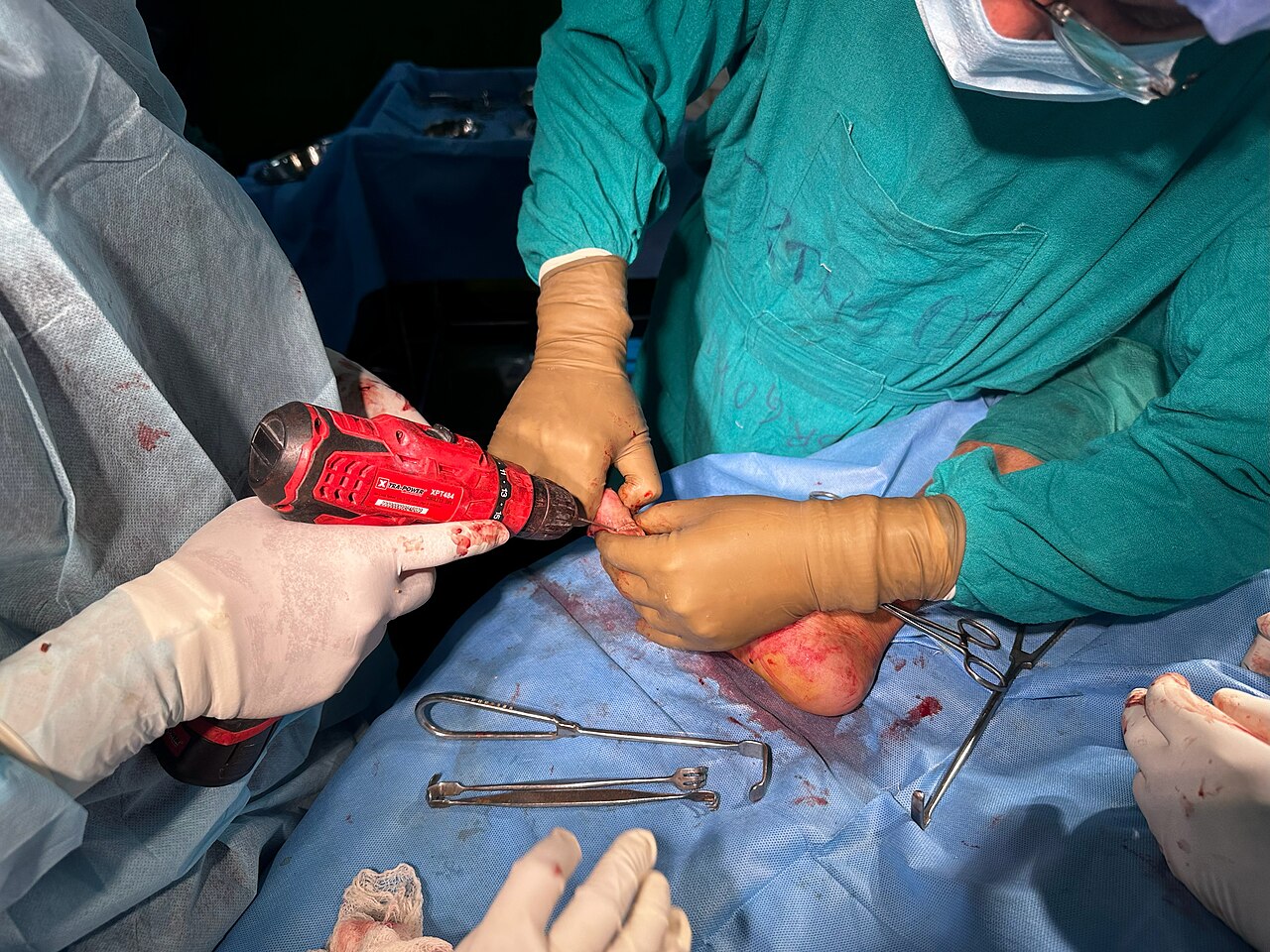
Salt Lake City biomaterials company SINTX Technologies has finished building its additive manufacturing facility and taken delivery of EXT-220 MED medical-grade 3D printers, according to a November 27 report from 3D Printing Industry. The equipment is meant to produce personalized orthopedic implants from a composite of silicon nitride and PEEK, which SINTX calls SiN/PEEK and develops under its SiNERGY AM platform. A completed building and a set of printers on the floor do not add up to a product, though. What SINTX has laid out is a sequence that runs through a materials supplier, the FDA, and a phased rollout that starts with extremity implants and extends to other anatomical areas through 2027.
For makers who know material extrusion mainly from desktop machines and engineering-grade spools, the announcement is a useful look at what it takes to move a filament-based process into regulated medical manufacturing. Below, we go through what SINTX has said, what it has not said, and why it matters.
What exactly did SINTX finish?
The company says its AM facility is built and that its EXT-220 MED printers have arrived. SINTX is preparing the systems to produce personalized implants, meaning devices shaped to one person's anatomy instead of picked from a range of standard sizes. SINTX management considers the SiNERGY platform central to its plan to build a diversified medical technology business, linking proprietary biomaterials, AI-assisted surgical planning, patient-specific implant design, and advanced manufacturing. The company's portfolio already includes an FDA-cleared product, the SiNAPTIC Foot & Ankle Osteotomy Wedge System for reconstructive surgery.
The company has also hired for the effort. James A. Smith, Ph.D., who holds a doctorate in additive manufacturing and mechanical engineering from Loughborough University, has been appointed Director of 3D Additive-Manufacturing. He will lead process development, material optimization, manufacturing validation, and the expansion of the custom and patient-specific device portfolio. Chief executive Eric K. Olson says the objective is to combine the design flexibility of 3D printing with the biological and mechanical properties of silicon nitride. SINTX is also in talks with an engineering services firm about AI-assisted medical image segmentation, anatomical modeling, and implant design. That is the step where medical imaging is turned into a printable patient-specific model, and the report says it only counts if it is developed and successfully integrated.
Where does the material come from?
This is the most important dependency in the plan. SINTX expects to receive compounded SiN/PEEK filament from Evonik before the end of 2026. In plain terms, compounding means the silicon nitride is blended into the PEEK polymer to make a feedstock, which then goes into the printers. The announcement does not describe a production route for this material that does not run through that delivery, so the filament is the item to watch.
SINTX has been working on this idea for years. A company page dated September 15, 2022 describes 3D printing medical implants from a silicon nitride/PEEK material, then branded FleX-SN PEEK, and stresses silicon nitride's biocompatibility as the reason to add it to the polymer. That page says SINTX had recently acquired polymer processing equipment, including a twin-screw extruder and a medical-grade 3D printer, to develop composite filaments. The new announcement shows the concept moving toward a production setting with an outside filament supplier.
Why put ceramic in PEEK at all?
The company's argument rests on biological performance. 3D Printing Industry cites a study of 3D printed SiN/PEEK spinal cage designs that found 93.9 percent less bacterial adhesion than conventional PEEK in laboratory testing, along with more cell proliferation. These are lab results, not clinical outcomes in patients, and they come from one study of one device type. The report itself notes that how much such results matter clinically for a given implant still has to be shown through product-specific evaluation and validation. Still, they explain why a company would take on a composite feedstock. In implants, bacterial colonization and poor tissue integration are serious failure modes, and a material that resists the first while supporting the second addresses a real problem.
Anyone who has printed filled filaments will recognize the trade-off. Adding particles to a polymer changes how it flows, how it wears hardware, and how layers bond. In a medical setting, each of those variables would have to be characterized and controlled, not just tuned until a test print looks right. SINTX itself lists manufacturing validation as one of the things its broader distribution depends on.
What is the regulatory path?
SINTX is seeking FDA 510(k) clearance for what it calls a defined design envelope of patient-specific extremity implants. The idea is worth understanding. With patient-specific devices, every implant differs from the last, so a manufacturer can't easily clear one fixed geometry. A design envelope instead describes a set of limits within which individual custom designs would be made. For comparison, 3D Systems received 510(k) clearance in April 2024 for a patient-specific PEEK cranial implant, and that clearance covered the whole workflow: segmentation and modeling software, the EXT 220 MED printer, and Evonik's VESTAKEEP i4 3DF PEEK, run under a pre-defined production process. According to 3D Printing Industry, SINTX's submission would add a silicon nitride composite and extremity anatomy to that route.
The rollout is phased. For the first quarter of 2027, SINTX says it is looking at a limited number of opportunities to supply qualifying custom devices, and it intends to provide some products under the FDA custom device exemption. Broader distribution of individualized implants depends on regulatory clearances and on completing manufacturing validation. Craniomaxillofacial (CMF) and spinal applications are planned for later in 2027, subject to regulatory review and other factors. Starting with extremities lines up with the company's existing cleared product, which is a foot and ankle system.
The timeline depends on several things happening in order: Evonik filament delivered on schedule, manufacturing validation on the new printers, and FDA's response to the design-envelope submission. Any of them could move the dates. The plan as announced is a target, not a guarantee.
What It Means for Makers
Most readers will never print an implant, but the SINTX plan shows where filament-based printing is heading. A few points stand out:
- Feedstock becomes a supply chain. In hobby printing, a new composite is something you buy and try. In this plan, the filament is a compounded material from a named supplier, and the announced schedule depends on its delivery. SINTX's timeline leans on Evonik's.
- The machine is part of the process. SINTX is using a medical-grade printer, the EXT-220 MED, instead of a general engineering machine. The 3D Systems clearance described above also named the printer, the material, and the software as parts of one cleared workflow.
- Design automation is part of the plan. SINTX's talks about AI-assisted segmentation point to a workflow problem that also shows up on a smaller scale in maker communities: turning scans into printable geometry quickly and repeatably.
- Filled polymers keep getting more functional. Makers already use carbon-, glass-, and metal-filled filaments for stiffness or looks. SiN/PEEK is a case where the filler is chosen for a biological property, which is a different reason to compound a material.
Bottom Line
SINTX now has a building, printers, a dedicated AM director, and a phased plan for patient-specific silicon nitride/PEEK implants. What it is still waiting on is the compounded filament and the 510(k) clearance for the design envelope, and broader distribution depends on both plus completed manufacturing validation. The lab data on bacterial adhesion is promising but early. The first real milestone to watch is whether Evonik's compounded filament arrives by the end of 2026. The second is whether limited custom-device supply starts in the first quarter of 2027 as planned. If the plan holds, extremity implants will come first, with CMF and spine scheduled to follow later in 2027.
